
Sustainable Lighting & Energy Efficiency
Reducing carbon footprint through efficient design, smart controls, and circular economy principles.
The Energy Opportunity
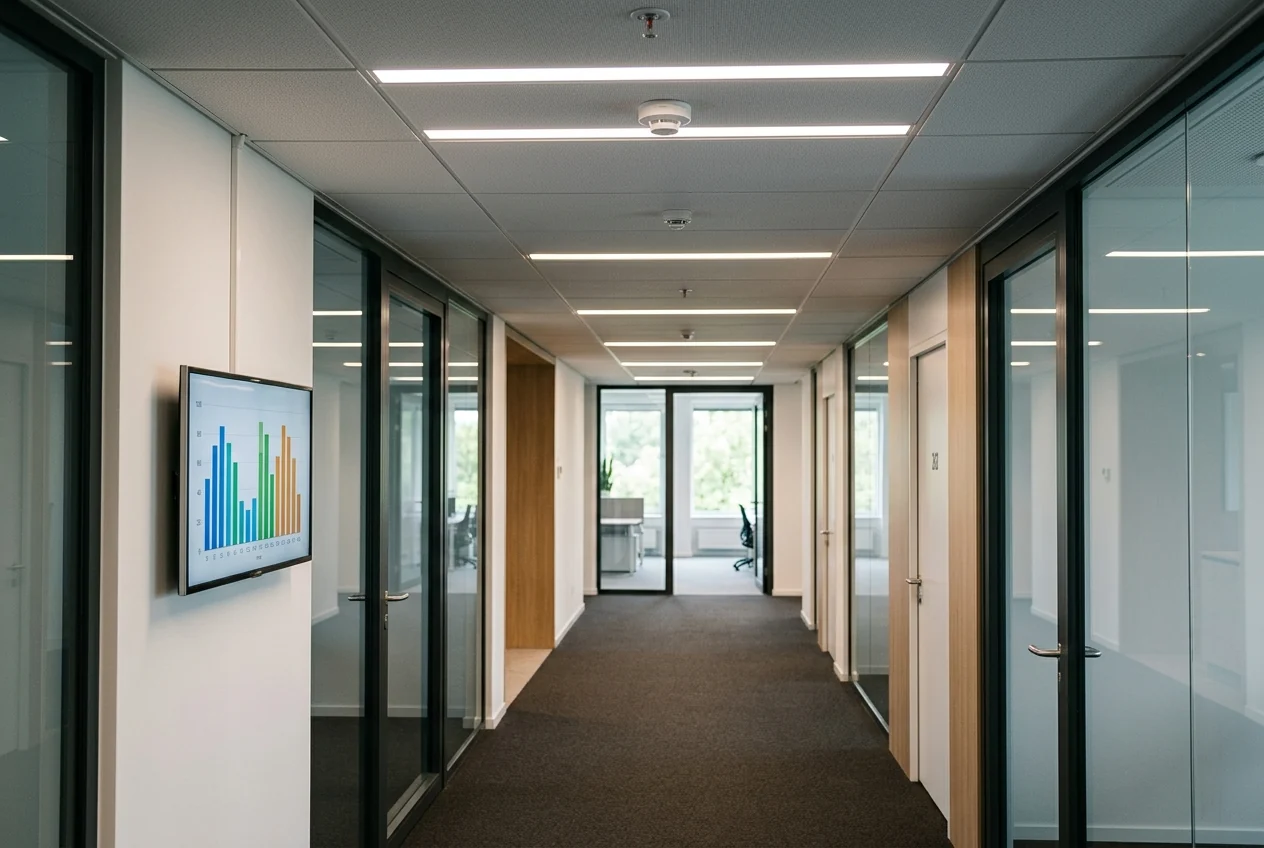
Lighting accounts for **15% of global electricity** and **5% of global CO2 emissions**. Switching from fluorescent to LED saves 40-60%. Adding smart controls saves another 30-50%. Combining daylight harvesting, occupancy sensing, and task-ambient design can achieve **total reductions of 70-85%**. For a 10,000 sqm office, this translates to 150-200 tonnes of CO2 per year.
Energy Efficiency Comparison
| technology | efficacy | lifespan | co2 per mlmh | status |
|---|---|---|---|---|
| Incandescent | 12-15 lm/W | 1,000h | 100% | Phased out |
| Halogen | 18-25 lm/W | 2,000-4,000h | 75% | Being phased out |
| CFL | 45-65 lm/W | 8,000-15,000h | 35% | Declining |
| T5/T8 Fluorescent | 80-100 lm/W | 20,000-30,000h | 25% | Still common |
| LED (standard) | 100-140 lm/W | 50,000h | 15% | Current standard |
| LED (premium) | 160-200+ lm/W | 80,000-100,000h | 8% | Available now |
Beyond LED: Smart Design
Switching to LED is step one. Real sustainability comes from **design optimization**: using task-ambient separation (30-40% energy reduction vs uniform), **daylight harvesting** (30-50% savings near windows), **occupancy dimming** (20-40% in meeting rooms and corridors), and **time scheduling** (eliminating after-hours waste). Each layer compounds, achieving the 70-85% total reduction.
Embodied Carbon
The lighting industry is beginning to address embodied carbon: the CO2 emitted during manufacturing, transport, and disposal. Aluminum heat sinks, electronic drivers, and rare-earth phosphors all have significant embodied carbon. Circular design principles, including driver-replaceable fixtures, recyclable housing materials, and take-back programs, are emerging as the next frontier in lighting sustainability.
Green Building Credits
Sustainable lighting earns credits in multiple green building systems: **LEED** (Energy & Atmosphere: LPD reduction, daylight, controls), **WELL** (Light concept: circadian, glare, color rendering), **Estidama** (Resourceful Energy: LPD targets), **BREEAM** (Energy: lighting controls, metering), **Al Sa'fat** (Dubai: LPD, sensors, daylight). Lighting is one of the easiest categories to score well in because the technology is mature and cost-effective.
Life Cycle Assessment
A complete sustainability assessment considers: **operational energy** (80-90% of lifetime impact), **embodied carbon** (manufacturing, materials), **transport emissions**, **maintenance** (replacement frequency, waste generated), and **end-of-life** (recycling, landfill, hazardous materials). LED scores well on operational energy but has room for improvement on end-of-life recycling of electronic components and rare-earth phosphors.