
Circadian Lighting & Human-Centric Design
How tunable white LEDs align artificial light with our biological clock.
What Is Circadian Lighting?
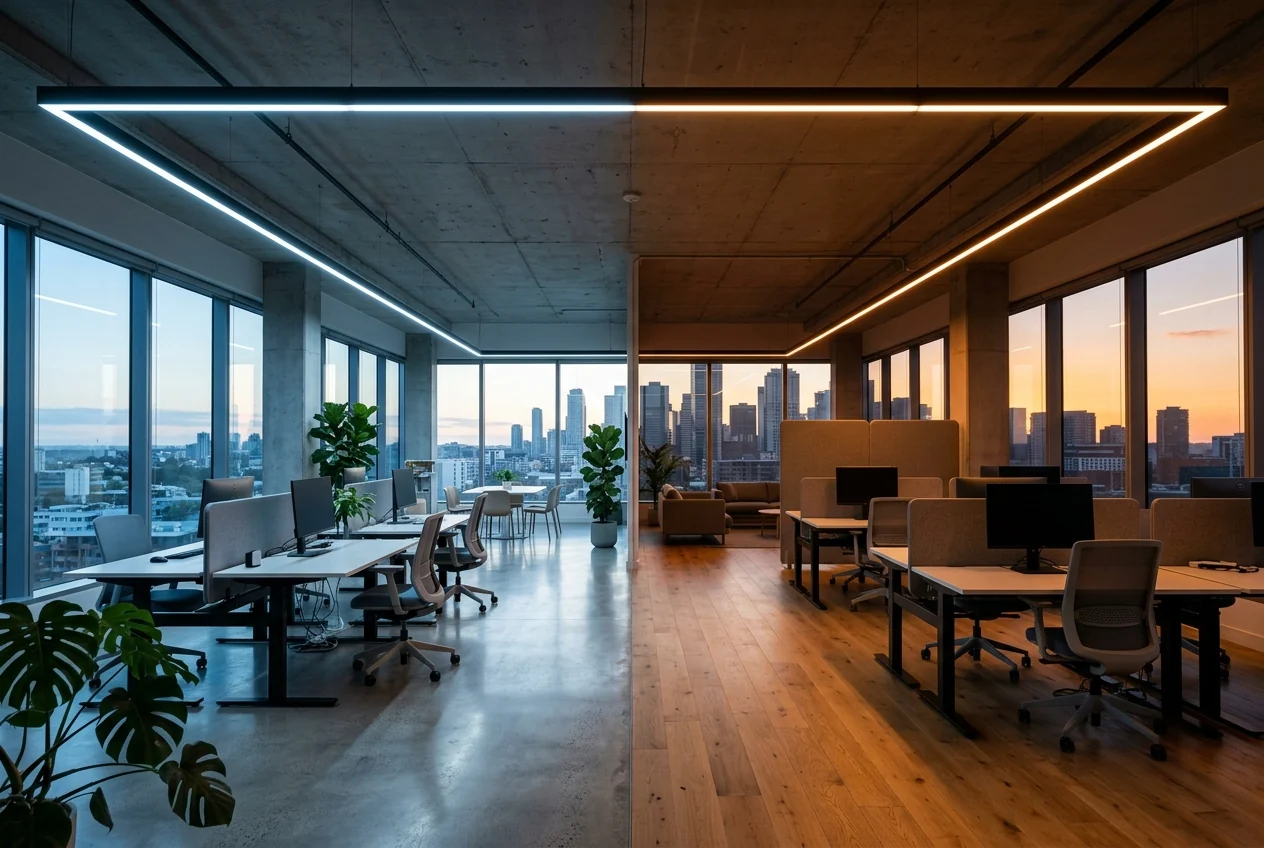
Circadian lighting mimics the natural progression of daylight throughout the day. In the morning, warm amber tones (2700K) ease the transition from sleep. By midday, cooler, brighter light (5000-6500K) promotes alertness and focus. In the evening, the system returns to warm dimmed tones to prepare the body for rest. This is achieved using **tunable white LED fixtures** that blend warm and cool LED arrays on a single module.
Circadian Lighting Schedule
| time | cct | intensity | effect |
|---|---|---|---|
| 06:00-08:00 | 2700-3000K | 30-50% | Gentle wake-up, melatonin suppression begins |
| 08:00-12:00 | 4000-5000K | 80-100% | Peak alertness, maximum productivity |
| 12:00-14:00 | 5000-6500K | 100% | Counteracts post-lunch dip, sustained focus |
| 14:00-17:00 | 4000-4500K | 70-90% | Sustained productivity, gradual wind-down |
| 17:00-20:00 | 3000-3500K | 50-70% | Relaxation begins, melatonin production starts |
| 20:00+ | 2200-2700K | 20-40% | Sleep preparation, minimal blue content |
The Science
The human eye contains intrinsically photosensitive retinal ganglion cells (ipRGCs) that detect blue-rich light (480nm peak) and signal the suprachiasmatic nucleus (SCN) to suppress melatonin. This is why cool white light keeps you awake and warm light lets you sleep. Well-designed circadian systems leverage this biology.
Key Technologies
**Tunable White Fixtures** blend 2700K and 6500K LED arrays. **DALI DT8** protocol enables per-fixture CCT + intensity control from a single gateway. **Astronomical clocks** or **BMS integration** automate the schedule based on local sunrise/sunset times. For simpler installations, **standalone sensors** with daylight harvesting can approximate circadian behavior.
Applications
**Offices:** Improved focus and reduced afternoon fatigue. Studies show a 12% productivity increase. **Hospitals:** Faster patient recovery, especially in ICU and elderly care. **Schools:** Better concentration and reduced behavioral issues. **Senior Living:** Restores disrupted circadian rhythms, reducing sundowning in dementia patients.