
Smart Lighting & IoT Integration
Connecting luminaires to the cloud for data-driven building intelligence.
Beyond Simple Controls
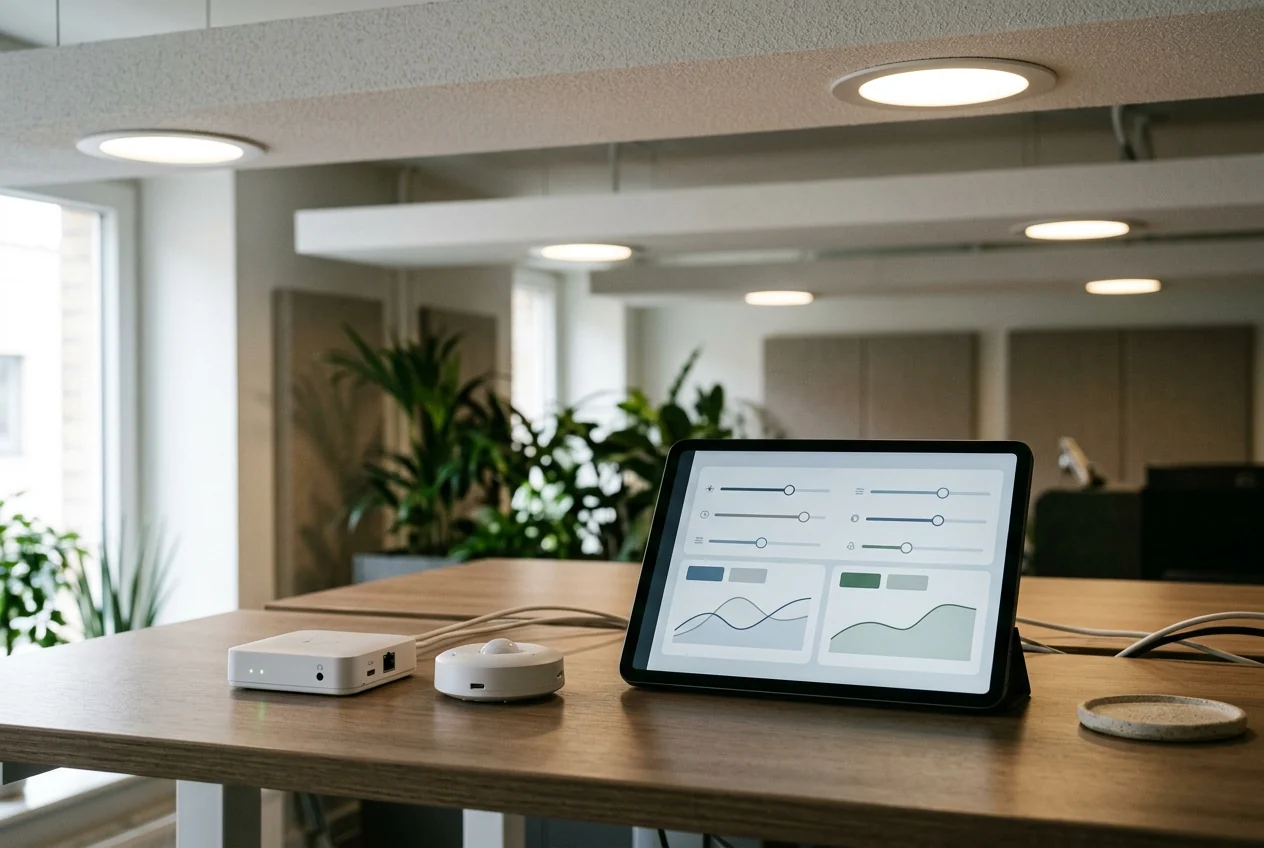
Traditional lighting control adjusts brightness. **Smart lighting** adds intelligence: each fixture becomes a network node with sensors (occupancy, daylight, temperature) and a unique IP address. Data flows to a cloud platform where algorithms optimize energy, map space usage, and trigger automated responses. The lighting infrastructure becomes a **building nervous system**.
Smart Lighting Capabilities
| capability | technology | benefit |
|---|---|---|
| Occupancy Analytics | PIR/radar sensors in fixtures | Space utilization data for real estate optimization |
| Daylight Harvesting | Ambient light sensors | 30-50% energy savings near windows |
| Indoor Positioning | Bluetooth/Li-Fi beacons in fixtures | Wayfinding, asset tracking, location services |
| Predictive Maintenance | Driver telemetry + ML | Replace fixtures before failure, reduce downtime |
| Energy Dashboard | Cloud platform + API | Real-time kWh monitoring per zone, carbon reporting |
| Demand Response | Grid integration | Auto-dim during peak demand, reduce utility costs |
Protocol Ecosystem
The smart lighting ecosystem uses layered protocols: **DALI-2** for reliable fixture-level control, **Bluetooth Mesh** or **Zigbee** for wireless sensor networks, **BACnet/IP** or **MQTT** for BMS integration, and **REST APIs** for cloud platform connectivity. The trend is toward **open standards** and **interoperability**, moving away from proprietary single-vendor lock-in.
Cybersecurity Warning
Connected luminaires are IoT devices on your network. Specify TLS 1.3 encryption, firmware update capability, network segmentation (lighting on its own VLAN), and certificate-based authentication. A compromised lighting network can be an entry point to the building's IT infrastructure.
ROI Calculation
Smart lighting ROI comes from multiple streams: **energy savings** (40-70% vs conventional), **space optimization** (occupancy data reduces real estate costs by 10-20%), **maintenance reduction** (predictive replacement vs reactive), and **tenant satisfaction** (personal control, comfort). Total ROI is typically 3-5 years, accelerated by utility rebates and green building certification credits.