
LED Lifespan - L70, L80 & Lifetime Ratings Explained
What LED lifespan numbers really mean and how to interpret manufacturer claims.

LEDs Don't Burn Out
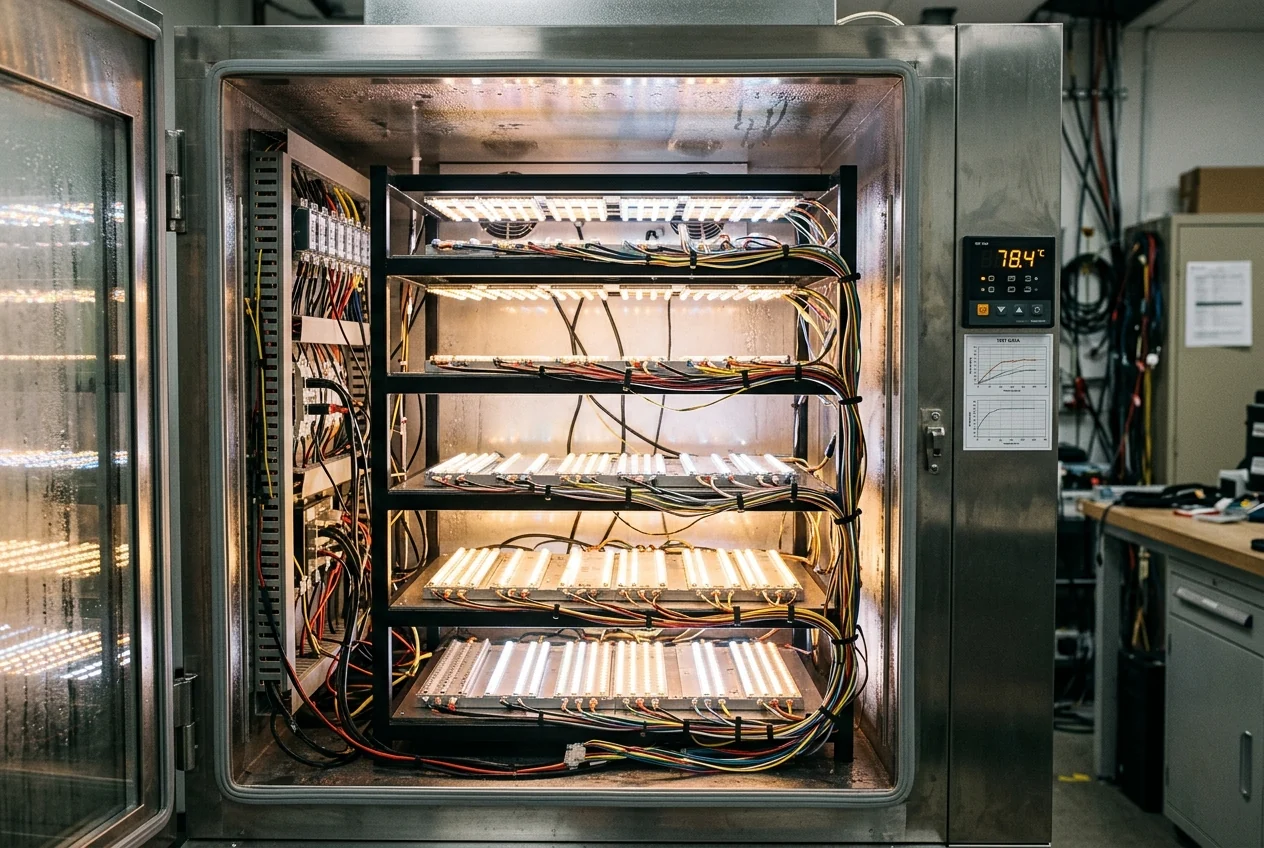
Unlike incandescent or fluorescent lamps that fail suddenly, LEDs gradually lose brightness over time. This is called **lumen depreciation**. An LED rated at L70 50,000h means that after 50,000 hours of operation, it will still produce at least **70% of its original light output**. The LED hasn't failed; it has just dimmed. This is fundamentally different from traditional lamp life.
Lumen Maintenance Ratings
| rating | meaning | typical use |
|---|---|---|
| L70 | 70% of initial lumens remaining | Standard specification, most common |
| L80 | 80% of initial lumens remaining | Higher quality, shorter rated hours |
| L90 | 90% of initial lumens remaining | Premium specification, critical applications |
| B10 | 10% of samples fall below Lxx | 90% of fixtures still above rated output |
| B50 | 50% of samples fall below Lxx | Average/median performance (less conservative) |
Reading the Full Rating
A complete rating looks like L80 B10 60,000h. This means: after 60,000 hours, 90% of fixtures (B10 = only 10% fall below) will still produce at least 80% of their original light output. The B-factor is often omitted in marketing materials, defaulting to B50 (median). Always ask for the full Lxx Byy rating.
What Affects Real-World Life?
**Temperature:** The biggest factor. Every 10C above rated operating temperature can halve LED life. **Drive Current:** Over-driving LEDs for higher output accelerates depreciation. **Power Quality:** Voltage spikes and poor power factor stress drivers (the driver often fails before the LED). **Environment:** Humidity, vibration, and chemical exposure degrade seals and connections.
Driver vs LED Failure
In practice, the **LED driver fails before the LED** in 60-70% of cases. Drivers contain electrolytic capacitors that degrade with heat and time. Specify driver life separately: look for **100,000h MTBF** or higher. Plan for **driver-replaceable** fixtures in critical applications so the entire luminaire doesn't need replacing when the driver fails.