
Back to Academy
Technical EngineeringElectrical Design
Voltage Drop in Low Voltage LED Systems
Why your LED strips dim at the end — and how to prevent it.
6 min LEDWORLD Technical Team 613 views

The Rule
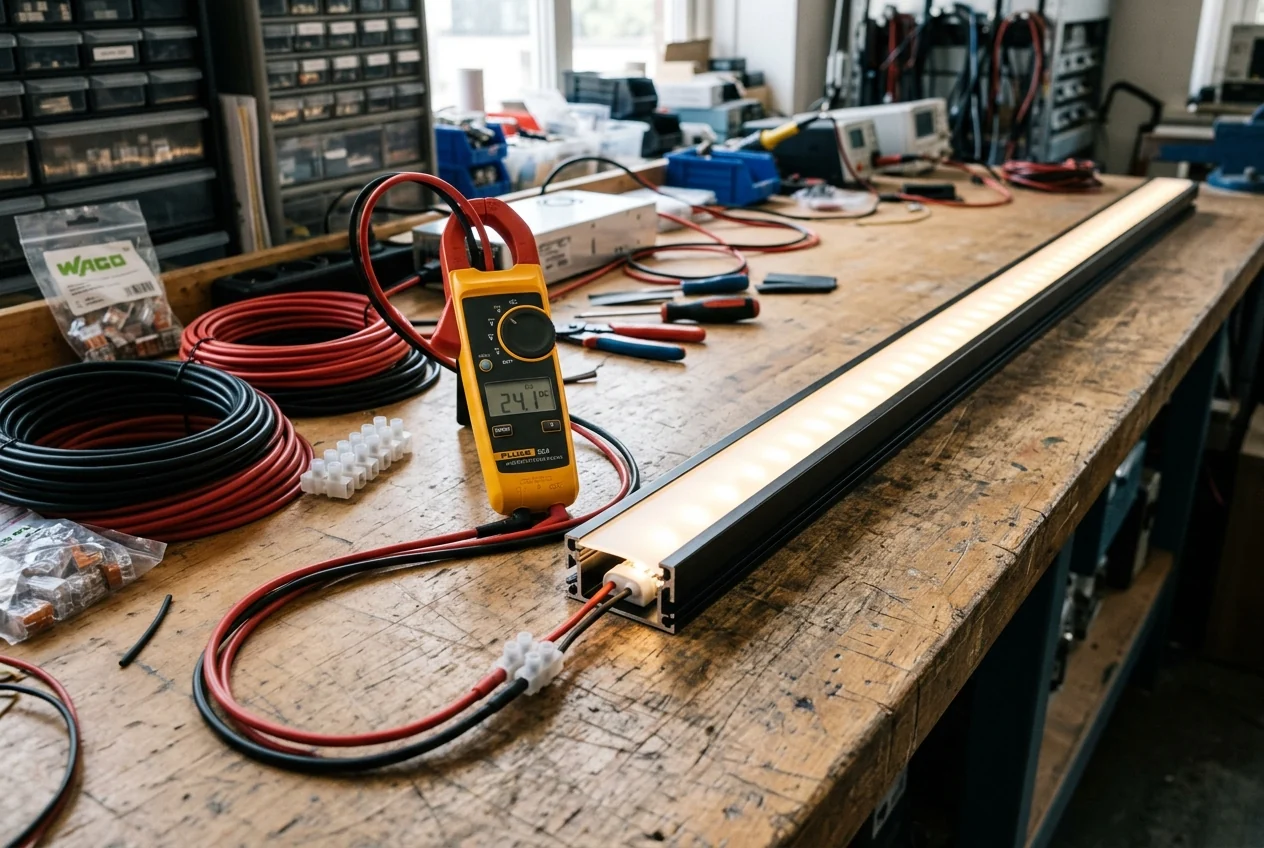
Keep voltage drop below 5% of system voltage. For 12V: max 0.6V drop. For 24V: max 1.2V drop. For 48V: max 2.4V drop. Beyond this threshold, LEDs dim visibly and color shifts.
Why It Happens
Every cable has resistance. As current flows through longer cable runs, voltage decreases. Low-voltage systems (12V, 24V) are especially vulnerable because even small voltage drops represent a large percentage of the total voltage.
Voltage Drop Risk by System
| system | max end feed | risk |
|---|---|---|
| 12V LED Strip | 5m typical | High — visible dimming beyond 5m |
| 24V LED Strip | 10m typical | Medium — longer runs possible |
| 48V LED Strip | 20m typical | Low — best for long runs |
| 12V LED Modules | 10 per string | Medium — follow module spec |
Prevention Strategies
Use 24V or 48V instead of 12V for runs longer than 5m
Center-feed strips instead of end-feeding to halve effective run length
Use thicker cable (1.5mm² instead of 0.75mm²) for long runs
Add parallel feed points every 5m on 12V, every 10m on 24V
Calculate voltage drop before installation — don't guess
Common Mistakes
Running 12V strips for 10m+ from one end — guaranteed visible dimming
Using thin 0.5mm² cable for high-wattage strip runs
Not measuring voltage at the far end during installation
Ignoring connector resistance — each connector adds drop
Related Tools
Frequently Asked Questions
Related Articles
voltage drop12V24V48VLED stripelectrical