
Office Lighting Design - Productivity & Wellness
How evidence-based lighting design boosts focus, reduces fatigue, and improves employee satisfaction.
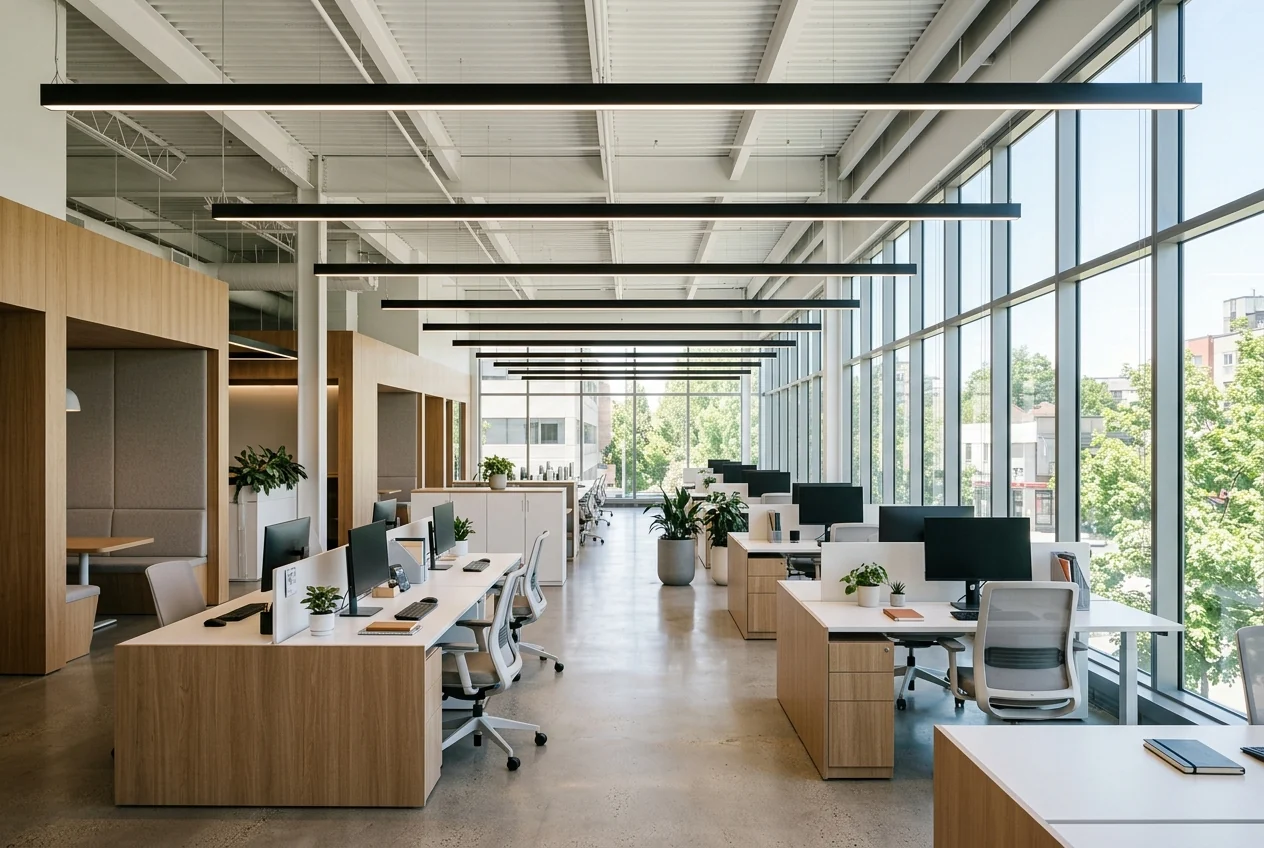
The Business Case
Lighting is 3-5% of a building's operating cost but affects 100% of occupant productivity. Studies by the World Green Building Council show that improved lighting design can increase productivity by **8-12%** and reduce absenteeism by **15%**. The WELL Building Standard awards up to 12 points for lighting quality, making it one of the highest-scoring categories.
EN 12464-1 Office Lighting Requirements
| area | maintained lux | ugr | cri | notes |
|---|---|---|---|---|
| Open-plan office | 500 lux | < 19 | 80+ | Measured at desk level (0.75m) |
| Private office | 500 lux | < 19 | 80+ | Include task light option |
| Meeting room | 500 lux | < 19 | 80+ | Dimmable for presentations |
| Reception/lobby | 300 lux | < 22 | 80+ | Higher accent for branding |
| Corridor | 100 lux | < 25 | 60+ | Motion-sensor dimming |
| Server room | 500 lux | < 25 | 60+ | Task-specific, maintenance access |
Controlling Glare (UGR)
**Unified Glare Rating (UGR)** is the most critical comfort metric in offices. UGR < 19 is required for screen-based work. Achieve this with **micro-prismatic diffusers**, **recessed parabolic louvres**, or **indirect-direct luminaires** where 40-60% of light goes upward. Avoid bare LED panels without optical control, as these are the primary cause of screen reflections and headaches.
Task vs Ambient Lighting
The modern approach separates **ambient** (general fill at 300 lux) from **task** (personal desk lamp adding 200-300 lux). This reduces overall energy consumption by 30-40% while giving individuals control over their workspace lighting. Pair with occupancy sensors and daylight harvesting for maximum energy savings.