
Landscape Lighting Design Principles
Creating drama, safety, and wayfinding in outdoor spaces after dark.

Core Techniques
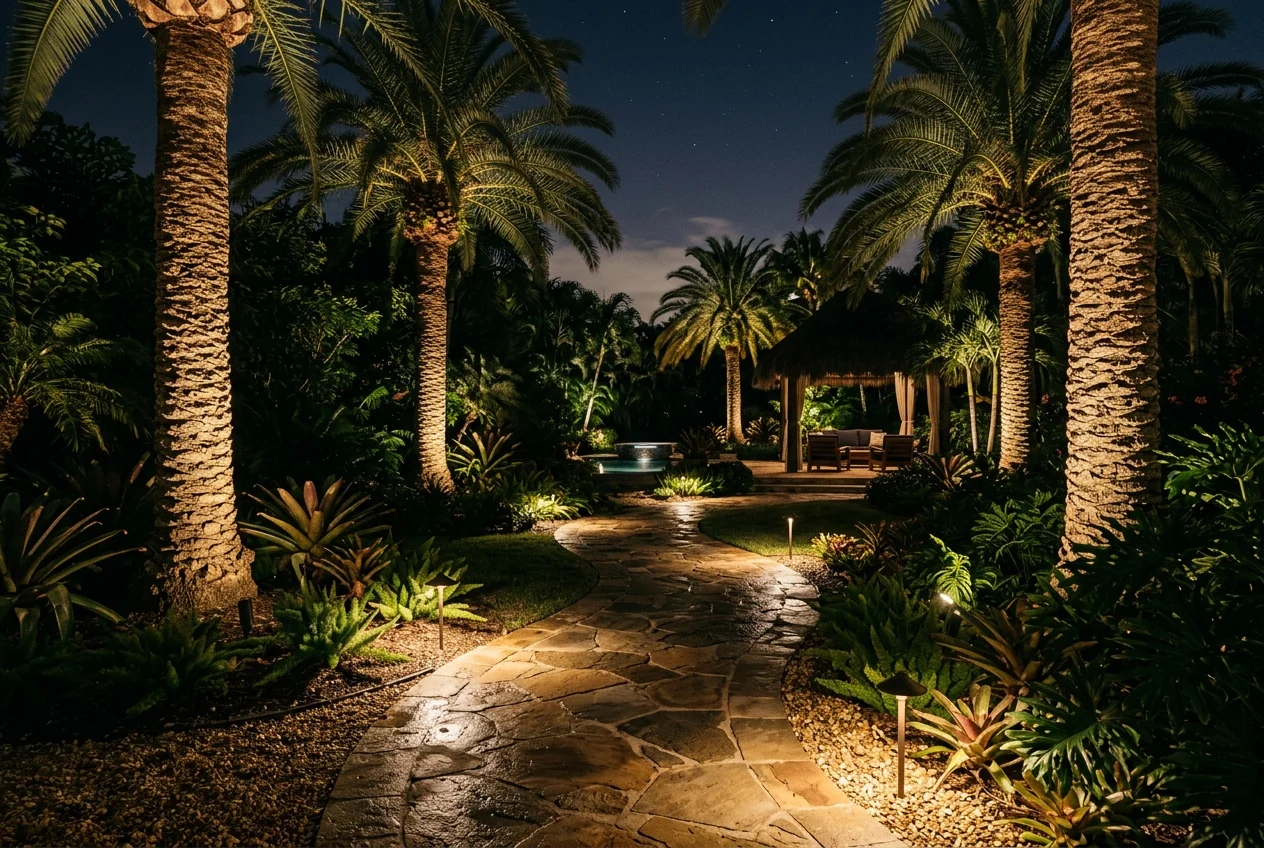
**Uplighting** trees and architectural elements creates vertical drama. **Downlighting/Moonlighting** from high in trees creates natural, dappled shadow patterns. **Path lighting** with bollards or step lights provides safe wayfinding. **Silhouetting** places lights behind plants to create dark outlines against lit walls. **Cross-lighting** uses two opposing fixtures to eliminate flat single-source shadows on trees and sculptures.
Landscape Lighting Zones
| zone | lux | technique | spacing |
|---|---|---|---|
| Primary pathways | 10-20 lux | Bollard/step lights | 2-3m centers |
| Secondary paths | 5-10 lux | Low-level markers | 3-5m centers |
| Feature trees | 50-100 lux (on trunk) | Uplighting | 1-2 fixtures per tree |
| Garden beds | 20-50 lux | Spread lights | As needed |
| Water features | Submerged | Underwater IP68 | Per design |
| Facade wash | 50-150 lux | Wall washer | Per facade width |
Less Is More
The biggest mistake in landscape lighting is overlighting. Professional designers use the reveal and conceal principle: illuminate key features and let less important areas fall into shadow. This creates depth, mystery, and visual hierarchy. If everything is lit equally, nothing stands out.
GCC-Specific Considerations
In the UAE and Gulf region, landscape lighting must cope with **extreme heat** (fixtures rated for 50C+ ambient), **sand ingress** (IP67+ for ground-level), **salt air** (marine-grade materials near coast), and **intense UV** (cable and housing degradation). Direct-burial cable must be UV-rated and sand-resistant. Irrigation system coordination is critical to avoid water spray on electrical components.