
Glare Control & UGR in Interior Lighting
Understanding and specifying visual comfort for screen-heavy work environments.
What Is UGR?
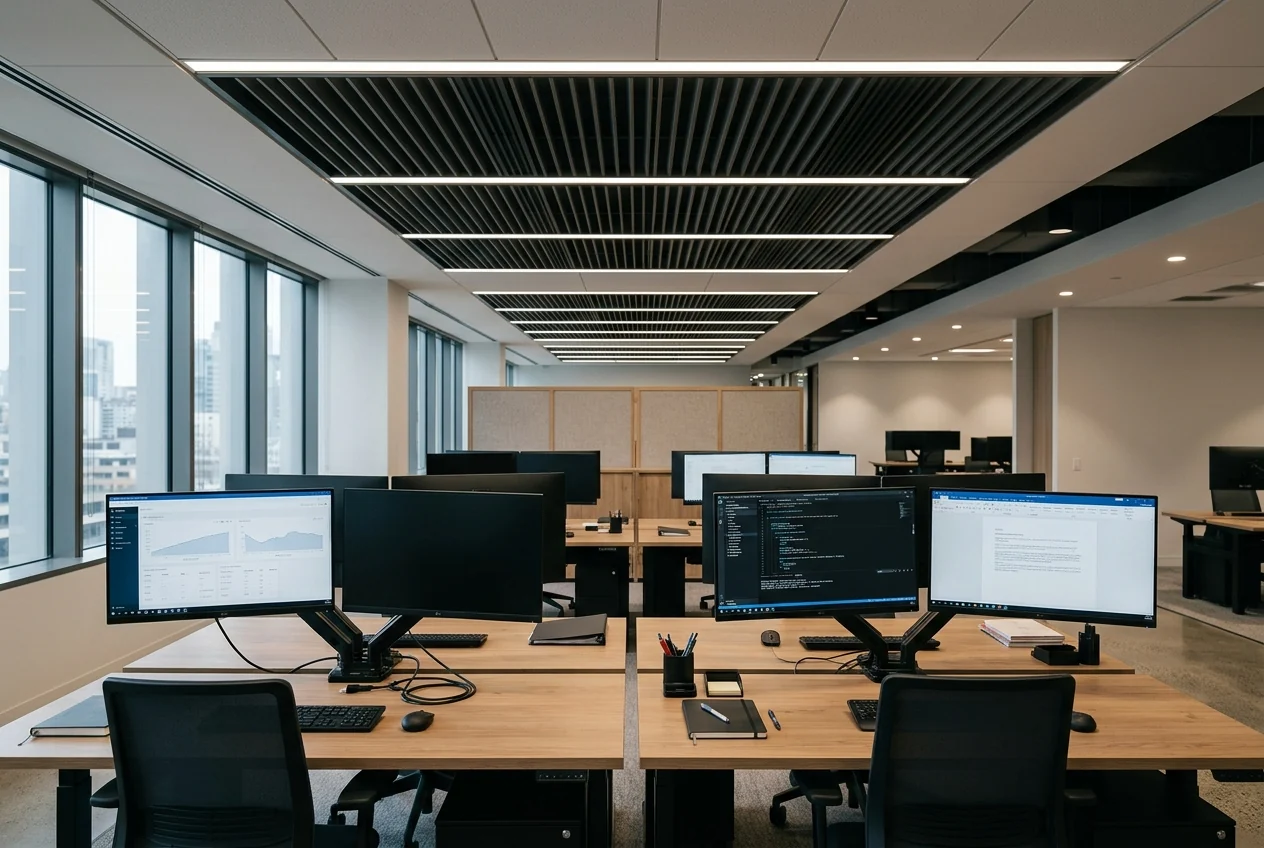
**Unified Glare Rating (UGR)** quantifies the discomfort glare from luminaires on a scale of 10-30. It depends on the luminaire's brightness, size, position relative to the viewer's line of sight, and the room's background luminance. EN 12464-1 specifies maximum UGR values for different tasks: **UGR < 19** for office work with screens, **UGR < 16** for technical drawing, **UGR < 22** for general areas.
UGR Requirements by Space
| space | ugr limit | method |
|---|---|---|
| Office with screens | < 19 | Micro-prismatic, indirect-direct |
| Technical drawing/CAD | < 16 | Indirect only, parabolic louvre |
| Classroom | < 19 | Micro-prismatic panels |
| Retail (general) | < 22 | Recessed, anti-glare trim |
| Industrial/workshop | < 25 | Standard diffuser acceptable |
| Hospital ward | < 19 | Indirect, bed-angle optimized |
Anti-Glare Technologies
**Micro-prismatic diffusers** use tiny prisms to redirect light downward while maintaining visual softness (UGR 16-19). **Parabolic louvres** use reflective cells to create sharp cut-off angles (UGR < 16). **Indirect-direct luminaires** send 40-60% of light upward to the ceiling, using the entire ceiling as a diffuse light source. **Recessed anti-glare trims** with deep-set LED modules hide the source from normal viewing angles.
The Screen Reflection Test
Before signing off on an office lighting design, perform the black mirror test: place a dark tablet screen flat on the desk and look at it from the seated position. If you can see luminaire reflections in the screen, the fixture placement or optics need adjustment. This is the single most practical test for real-world glare performance.