
LED Thermal Management - Heat Sink Design & Best Practices
Heat is the number one enemy of LED lifespan. Here's how to manage it.
Why Thermal Management Matters
LEDs don't burn out like incandescent bulbs; they gradually lose brightness over time. This process, called **lumen depreciation**, accelerates exponentially with temperature. For every 10C rise in junction temperature above the rated maximum, LED lifespan can halve. In the GCC, where ambient temperatures routinely exceed 45C, thermal management is not optional, it is critical.
Junction Temperature vs Lifespan
| junction temp | relative lifespan | lumen maintenance |
|---|---|---|
| 65C | 100% (rated) | L90 @ 50,000h |
| 75C | 80% | L80 @ 50,000h |
| 85C | 60% | L70 @ 50,000h |
| 95C | 40% | L70 @ 35,000h |
| 105C | 25% | L70 @ 20,000h |
| 115C+ | <15% | Rapid failure risk |
The GCC Factor
Standard LED thermal ratings assume 25C ambient. In Dubai, Riyadh, and Abu Dhabi, outdoor ambient temperatures reach 50C+ in summer. This means you need to derate every fixture by at least 25C above standard test conditions. A fixture rated for Tc 85C at Ta 25C only has 10C of headroom at 50C ambient.
Heat Sink Design Principles
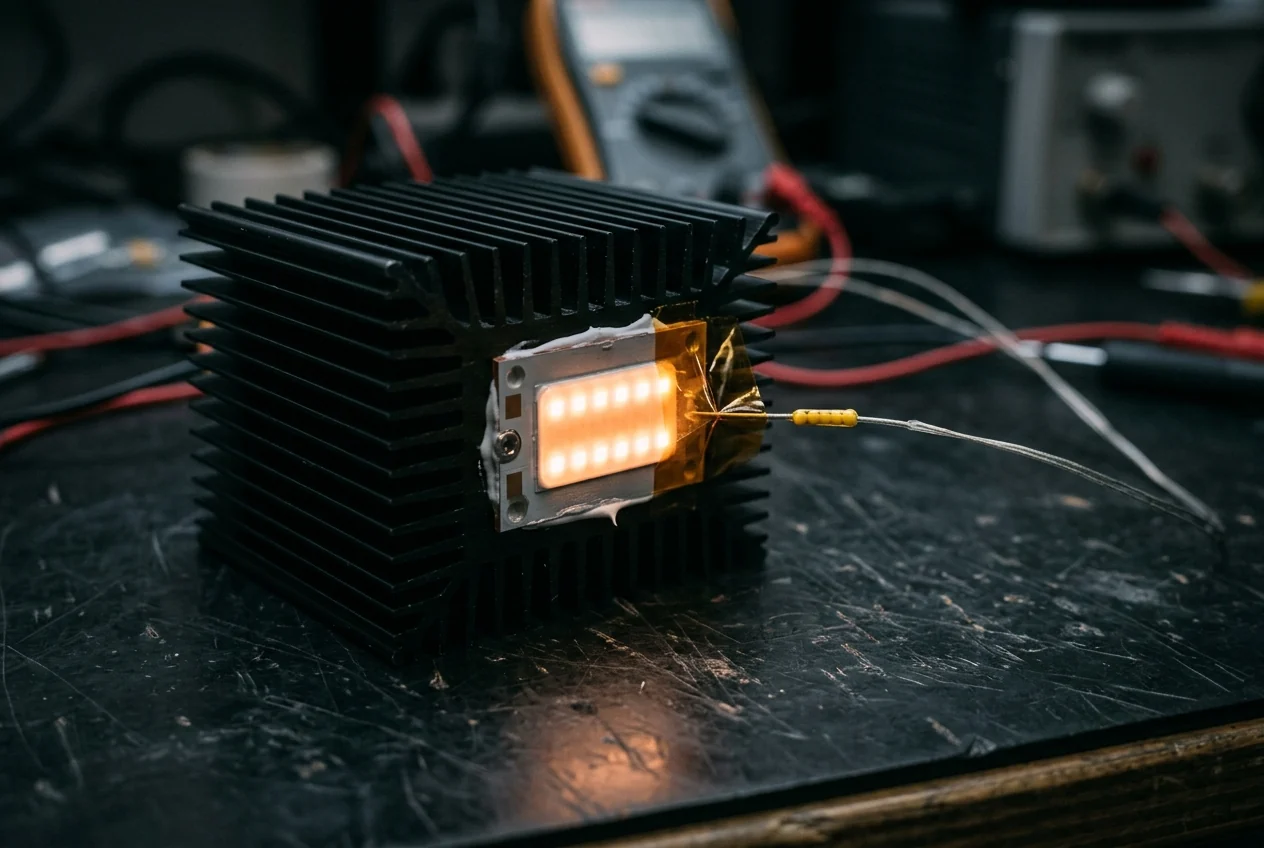
**Passive cooling** uses extruded or die-cast aluminum fins to dissipate heat via convection. Fin spacing, height, and surface area determine thermal resistance (Rth). **Active cooling** adds fans or forced air for high-power fixtures (>100W). **Thermal interface materials (TIM)** like thermal paste or pads fill microscopic air gaps between the LED module and heat sink, reducing thermal resistance by up to 60%.
Material Selection
**Aluminum 6063-T5** is the industry standard for extruded heat sinks (thermal conductivity 200 W/mK). **Die-cast aluminum ADC12** is used for complex shapes (96 W/mK). **Copper** offers the best conductivity (385 W/mK) but is heavy and expensive, used only for high-power downlights. **Graphite sheets** are emerging for ultra-thin fixtures (up to 1500 W/mK in-plane).