
Parking & Road Lighting Standards
Designing safe, energy-efficient lighting for parking structures and roadways.
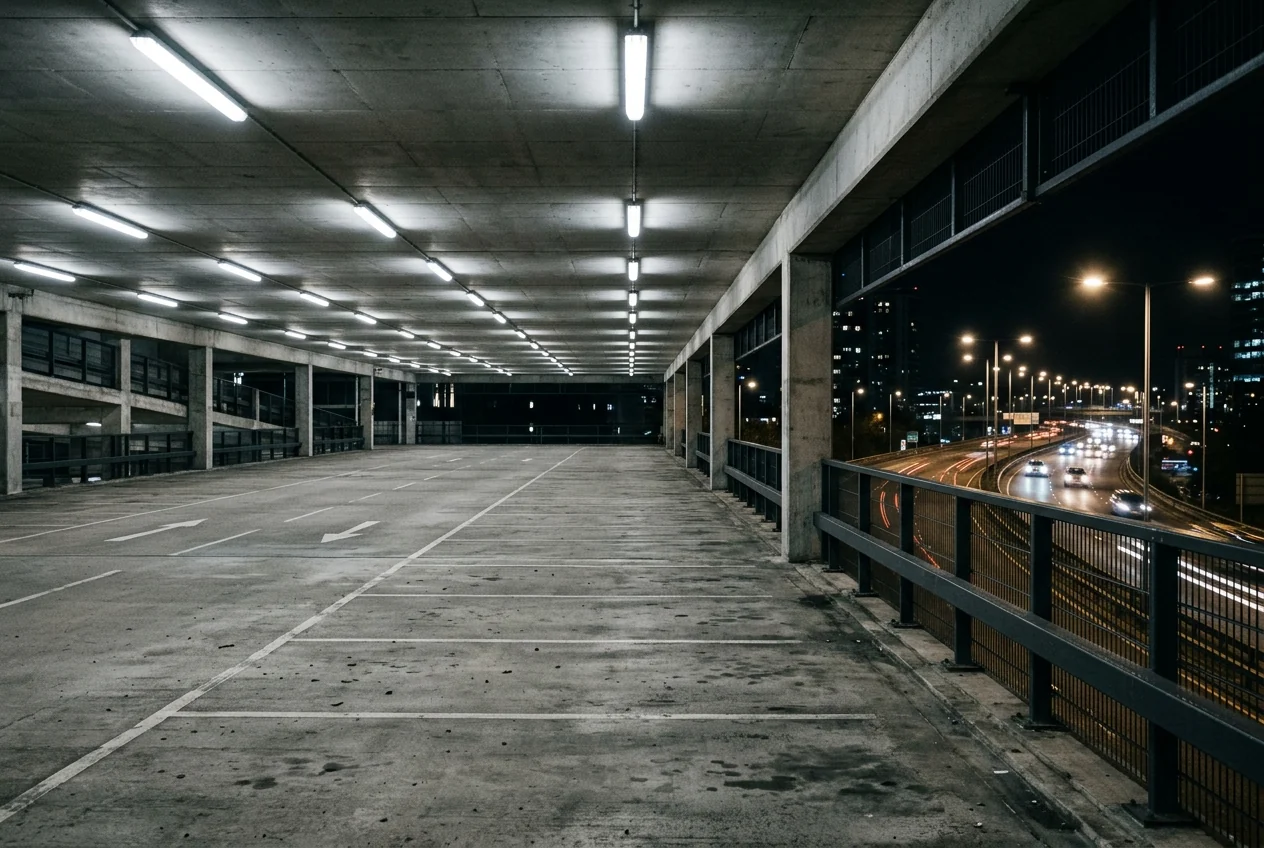

Standards Framework
Road and parking lighting is governed by **EN 13201** (Europe/international), **BS 5489** (UK), and local municipality codes. In the GCC, Abu Dhabi's **DOT Manual** and Dubai's **RTA standards** define road lighting classes. The key metric is **maintained average illuminance** with **uniformity ratio (Uo)** ensuring no dark spots where accidents or crime could occur.
Parking Lighting Requirements
| area | maintained lux | uniformity | notes |
|---|---|---|---|
| Open-air surface parking | 10-20 lux | Uo > 0.25 | Minimum for security |
| Covered multi-storey | 75-100 lux | Uo > 0.40 | Facial recognition distance |
| Entrance/exit ramps | 300 lux (day) | Uo > 0.40 | Adaptation zone required |
| Pedestrian areas | 50 lux | Uo > 0.40 | Vertical illuminance for safety |
| EV charging bays | 100 lux | Uo > 0.40 | Enhanced for plug/cable handling |
| Emergency exits/stairs | 100 lux | Uo > 0.40 | Battery backup required |
Smart Parking Controls
Modern parking LED systems use **DALI or wireless mesh** networks with **PIR or microwave occupancy sensors**. Empty zones dim to 20-30% (saving 60-70% energy), brightening to 100% when a vehicle or pedestrian is detected. **Daylight sensors** at perimeter zones further reduce consumption. ROI on smart parking lighting is typically 18-24 months.
Adaptation Zones
The transition from bright outdoor sunlight to a dark parking structure causes temporary blindness. Design adaptation zones at entrances: maintain 300 lux for the first 15-20m, then step down gradually to the interior level. This is a critical safety requirement often overlooked in design.