
Lighting for Healthcare & Patient Recovery
Evidence-based lighting design that supports healing, staff performance, and patient comfort.
Light as Medicine
Research by the Center for Health Design shows that patients in rooms with quality lighting and natural daylight **recover 2.6 days faster** and require **22% less pain medication**. For staff, proper lighting reduces **medication errors by 30%** and improves alertness during night shifts. Healthcare lighting is not just functional, it is therapeutic.
Healthcare Lighting Requirements
| area | lux | cct | special |
|---|---|---|---|
| Patient room (ambient) | 100 lux | 2700-3000K (dimmable) | Circadian tunable preferred |
| Patient room (examination) | 300-500 lux | 4000K | CRI 90+, separate switch |
| Operating theatre | 1000+ lux (ambient) | 4000-5000K | CRI 95+, surgical light 100,000+ lux |
| Nurse station | 500 lux | 4000K | Circadian tunable, anti-glare |
| Corridor (day) | 200 lux | 3500-4000K | Night mode: 50 lux, 2700K |
| Waiting area | 300 lux | 3000K | Calming, residential feel |
Night Mode Is Critical
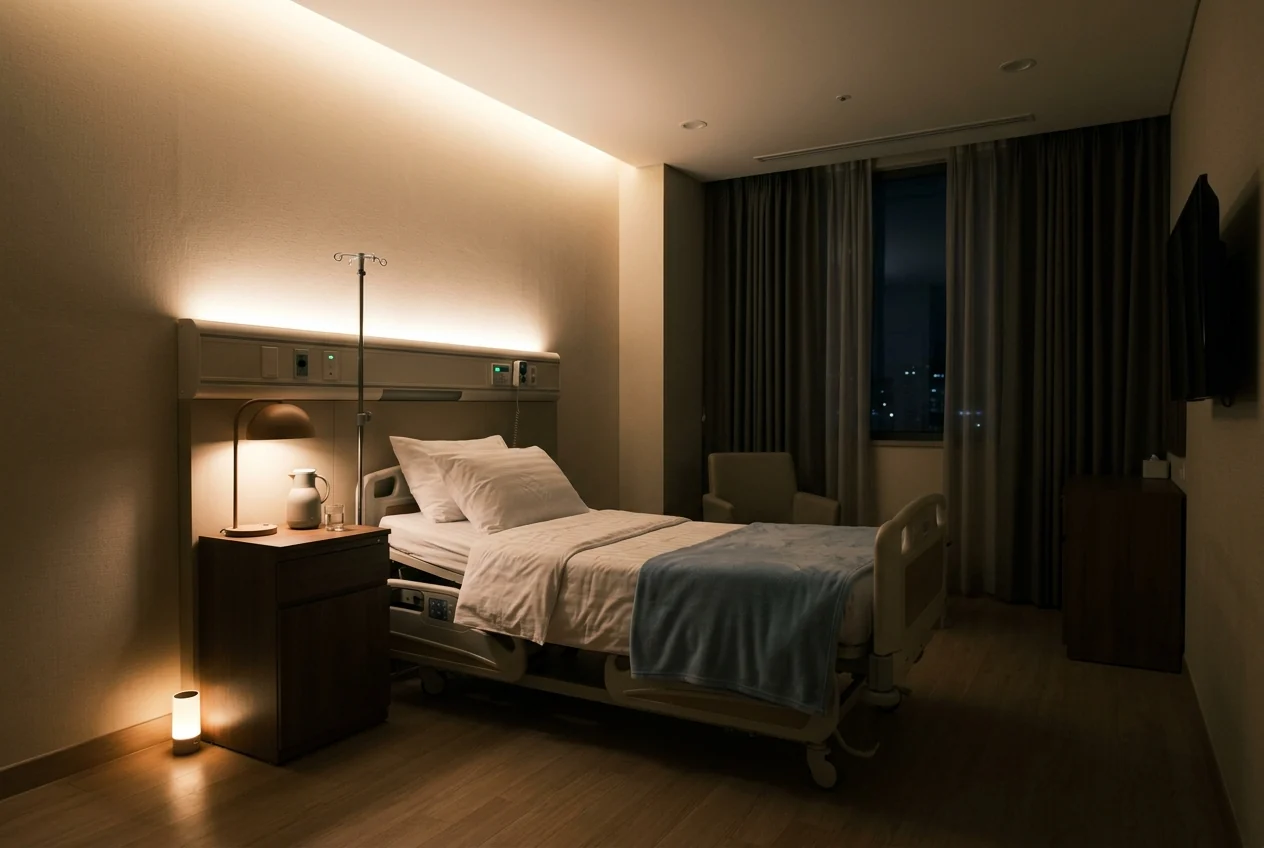
Hospital corridors at 3 AM should not be at 200 lux / 4000K. Light spilling under doors disrupts patient sleep. Design a night mode circuit: 50 lux maximum, 2700K warm white, with low-level LED strips along corridor walls instead of ceiling fixtures. Nurse stations maintain 300 lux locally. This simple change improves patient sleep quality by 40%.
Patient Room Design
Each patient room needs 4 lighting modes: **Ambient** (100 lux, warm, for relaxation), **Reading** (300 lux at bed, individual control), **Examination** (500 lux, 4000K, CRI 90+ for clinical assessment), and **Night** (10 lux, amber, path to bathroom). A bedside control panel allows patients to switch modes independently. Circadian tunable ambient is increasingly specified in premium hospitals.
Infection Control Considerations
Light fixtures in healthcare must be **sealed, flush-mounted, and easy to clean**. No exposed crevices that harbor bacteria. **IP54+ rating** for fixtures in wet areas (bathrooms, wash stations). Some facilities now specify **UV-C disinfection** fixtures that activate when rooms are unoccupied. Fixture materials must be compatible with hospital-grade cleaning chemicals.