
Sports Facility & Arena Lighting Standards
Meeting broadcast-quality illumination requirements for professional sports venues.
Why Sports Lighting Is Different
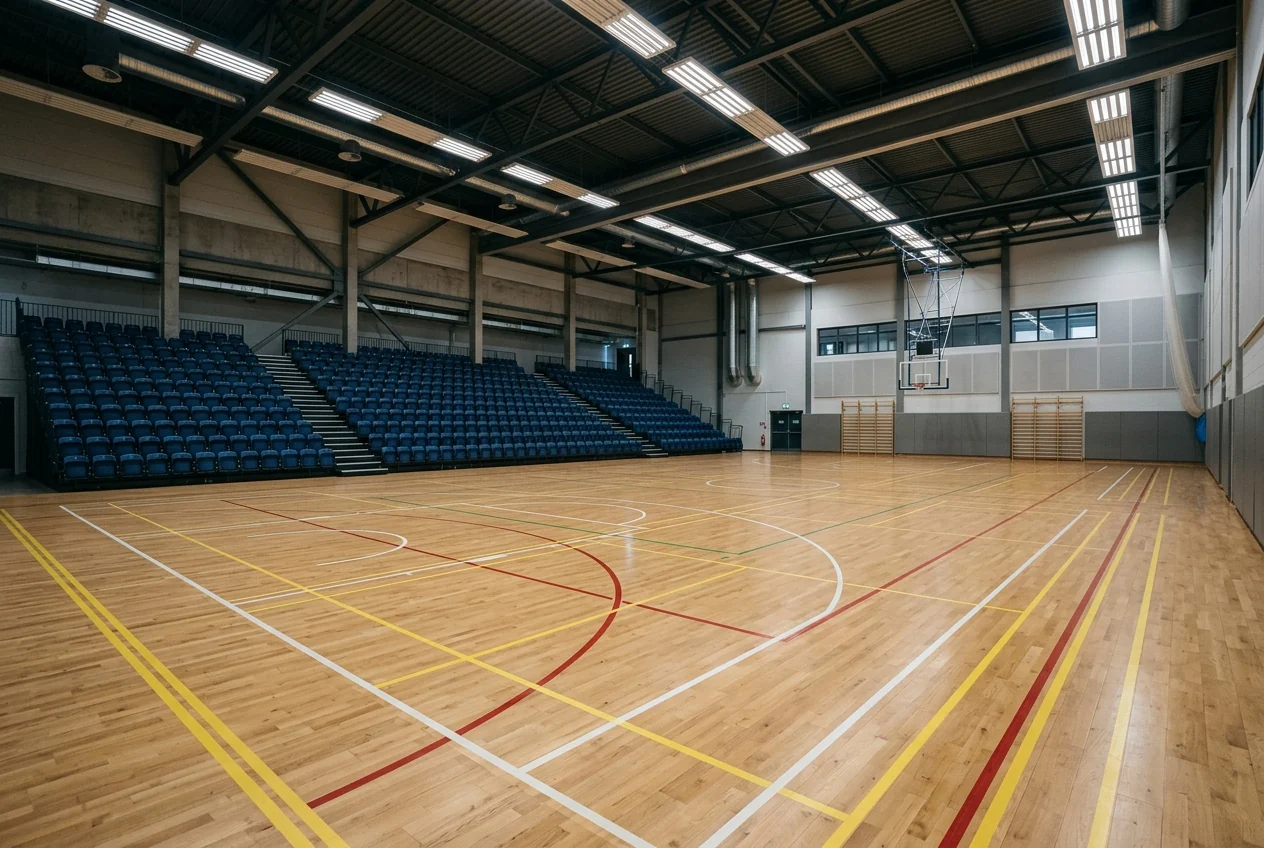
Sports lighting operates at extreme levels: 500-2000+ lux horizontal on the playing surface, with strict uniformity ratios. **Broadcast TV** adds further demands: 1400+ lux vertical illuminance for HD cameras, 2000+ for 4K/8K, with flicker-free operation at frequencies well above camera shutter speeds. LED has replaced metal halide because of instant restrike, precise dimming, and superior CRI.
Sports Lighting Standards
| standard | horizontal lux | uniformity | cri | cct |
|---|---|---|---|---|
| FIFA Class I (World Cup) | 2000 lux | U1 > 0.7, U2 > 0.8 | CRI 80+ | 5000-6500K |
| FIFA Class III (Training) | 500 lux | U1 > 0.5, U2 > 0.6 | CRI 65+ | 4000-6500K |
| UEFA Category 4 (Champions League) | 1800+ lux | U1 > 0.6, U2 > 0.7 | CRI 80+ | 5600K |
| ICC International Cricket | 1500 lux | U1 > 0.7 | CRI 80+ | 5000-6500K |
| Olympic Standard | 2000+ lux | U1 > 0.7, U2 > 0.8 | CRI 90+ | 5600K |
| Community/Amateur | 200-300 lux | U1 > 0.4 | CRI 65+ | 4000-5000K |
Flicker Index
LED drivers for sports must deliver <1% flicker at frequencies >3kHz. Standard 100Hz flicker (from simple drivers) creates visible banding on slow-motion TV replays. Specify drivers with high-frequency PWM dimming or constant-current regulation. This is a non-negotiable broadcast requirement.
High Mast Design
Stadium floodlights are mounted on masts 25-45m high, carrying 8-40 fixtures per mast. **Aiming angles** are calculated to achieve target uniformity using photometric software (Dialux, AGi32, Relux). Each fixture may draw 500-2000W. **Structural wind loading** is critical: large LED fixtures have higher wind resistance than compact halide fixtures. GCC dust storms create additional loading that must be factored into mast structural calculations.