
Power-over-Ethernet (PoE) Lighting Systems
Delivering power and data to luminaires through a single Ethernet cable.
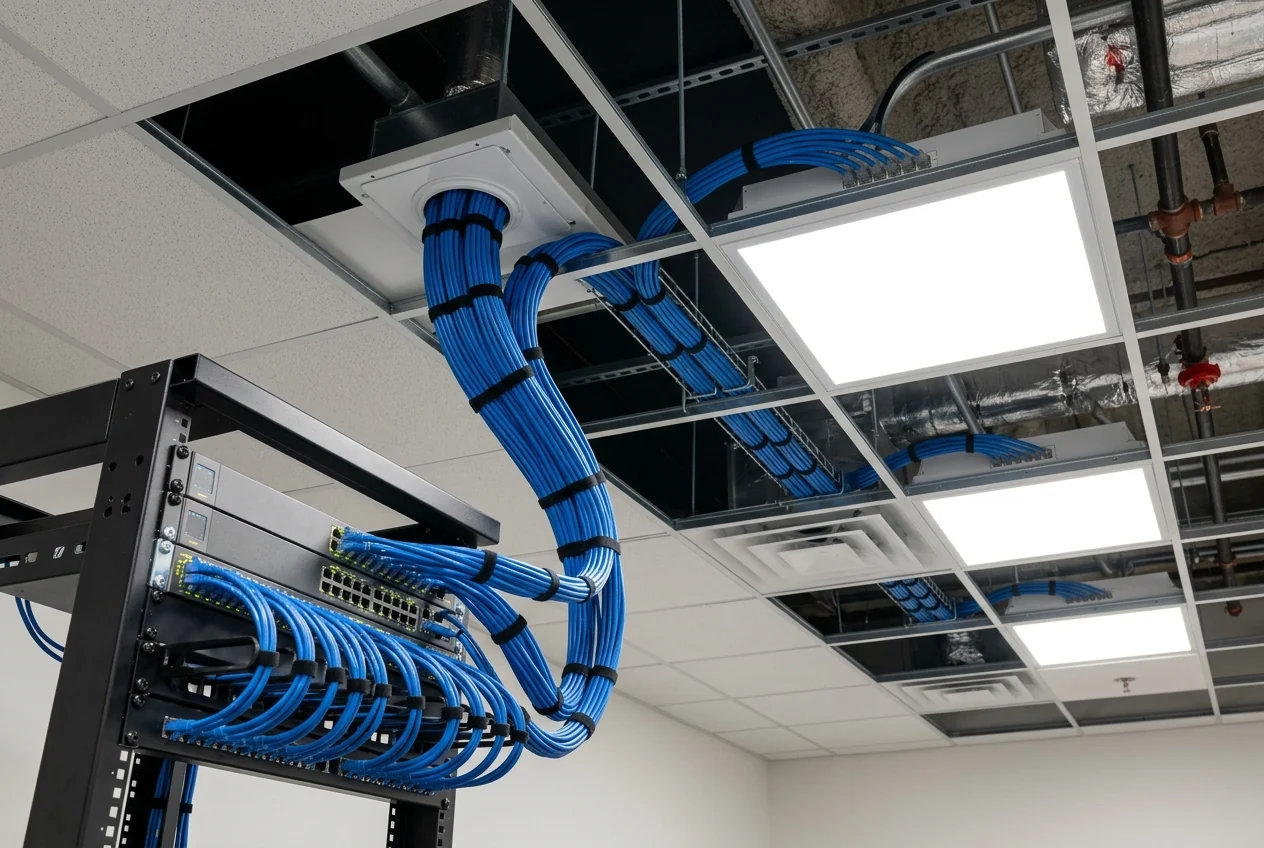

How PoE Lighting Works
PoE uses standard **CAT5e/CAT6 Ethernet cables** to deliver both DC power and data to each luminaire. An **IEEE 802.3bt (PoE++)** switch provides up to **90W per port**, sufficient for most LED fixtures. Each fixture gets a **unique IP address** and communicates directly with the building network. No traditional AC wiring, conduit, or circuit breakers are needed for the lighting circuits.
PoE Standards & Power Levels
| standard | max power | voltage | suitable for |
|---|---|---|---|
| IEEE 802.3af (PoE) | 15.4W per port | 44-57V DC | Individual downlights, small panels |
| IEEE 802.3at (PoE+) | 30W per port | 50-57V DC | Standard LED panels, linear fixtures |
| IEEE 802.3bt (PoE++) | 60-90W per port | 50-57V DC | High-output panels, multi-sensor fixtures |
Low Voltage = Simplified Installation
PoE operates at safe Class 2 low voltage (<60V DC). This means no licensed electrician is required for cable installation in many jurisdictions. Standard IT cabling technicians can install the infrastructure. This reduces installation cost by 20-40% and dramatically shortens project timelines.
Advantages Over Traditional
**Granular Control:** Each fixture is individually addressable via IP. **Rapid Reconfiguration:** Changing lighting zones is a software change, not rewiring. **Data Integration:** Sensors in fixtures feed occupancy, temperature, and daylight data to the BMS. **Energy Monitoring:** Per-fixture power measurement is built into the switch. **Reduced Cable Cost:** One cable type replaces AC power + DALI control cables.
Limitations
**Cable Length:** Maximum 100m from switch to fixture (Ethernet limit). **Power Budget:** Large floors need multiple PoE switches, each with limited port power. **Fixture Selection:** Not all luminaire manufacturers offer PoE-compatible fixtures. **UPS Requirement:** Centralized PoE switches need UPS for emergency lighting compliance. **Heat in Cables:** Running multiple high-power PoE cables in tight bundles generates heat, requiring cable derating.