
Photobiological Safety — Blue Light Hazard & IEC 62471
Understanding the real risks of LED blue light exposure, UV output, and how to specify safe luminaires.
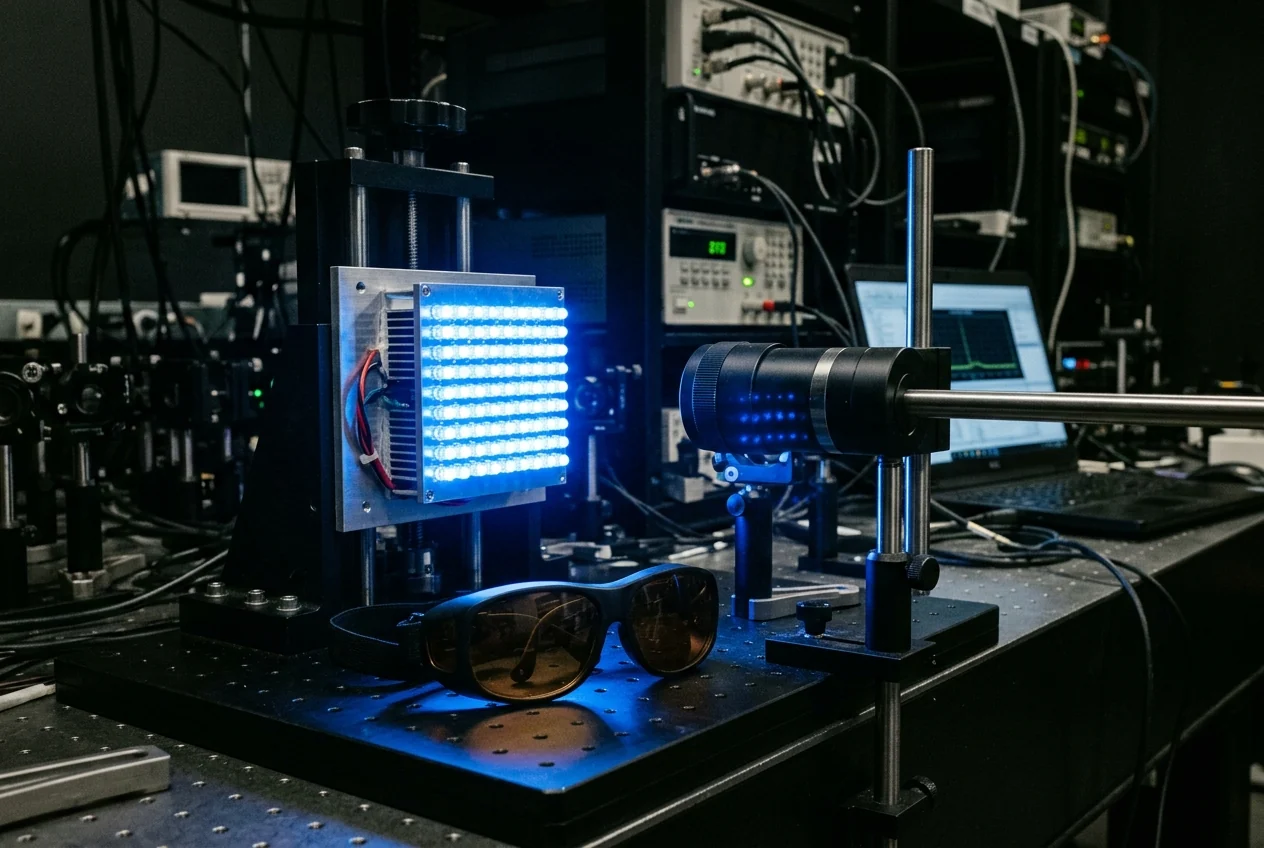
Photobiological Safety — Facts vs Fear
The 'blue light hazard' has generated significant public concern, much of it disproportionate to the actual risk from architectural LED lighting. Understanding the science and standards is essential for specifiers to make informed decisions — neither dismissing all concerns nor overreacting to marketing hype. IEC 62471 (Photobiological Safety of Lamps and Lamp Systems) and its LED-specific guidance IEC/TR 62778 provide the framework for evaluating photobiological risk from lighting products.
IEC 62471 Risk Group Classification
| 0 | 1 | 2 | 3 |
|---|---|---|---|
| RG0 (Exempt) | No photobiological hazard under normal use | Most architectural LED luminaires, LED panels, diffused downlights | Safe for all applications — no restrictions |
| RG1 (Low Risk) | No hazard due to normal behavioral aversion | Some high-output LED spots, decorative exposed LEDs | Safe for general use — avoid prolonged staring at close range |
| RG2 (Moderate Risk) | Does not pose hazard due to aversion response to bright light | High-power projectors, some surgical lights, high-intensity spots | Use with caution — not for applications where people stare at the source |
| RG3 (High Risk) | Hazardous even for momentary exposure | UV curing, germicidal, specialized industrial | Not for general illumination — engineering controls required |
Blue Light in Architectural LED Lighting
All white LEDs use blue-emitting chips (440-460nm) coated with phosphor to produce broadband white light. This has led to concerns about retinal damage from blue light exposure. The reality for architectural lighting: • Virtually all diffused LED luminaires (panels, downlights, linear) are Risk Group 0 or RG1 — no photobiological hazard under normal use conditions. • The blue light exposure from a typical LED office ceiling at 500 lux is comparable to or less than daylight exposure at the same illuminance. • The primary concern is with direct viewing of very high-luminance LED point sources at close range for extended periods — this is relevant for LED video walls, bare LED strips near eye level, and extremely bright decorative pendants. • Children's environments deserve extra care — young lenses transmit more blue light to the retina. Specify diffused, low-luminance luminaires for nurseries and schools. The CIE position statement (2019) confirms: there is no evidence that typical LED lighting used in normal conditions causes adverse health effects.
UV Output from LEDs
Standard white LEDs produce negligible UV radiation — orders of magnitude less than fluorescent lamps. This makes LEDs ideal for museums and galleries where UV exposure damages artwork and textiles. However, specialty LEDs (UV-A, UV-C) used for curing, disinfection, or horticultural applications do produce significant UV and require specific safety measures per IEC 62471.