
Flicker & Temporal Light Artifacts — SVM, PstLM & IES TM-39
Understanding LED flicker metrics, health impacts, and how to specify flicker-free lighting systems.
What Is Flicker?
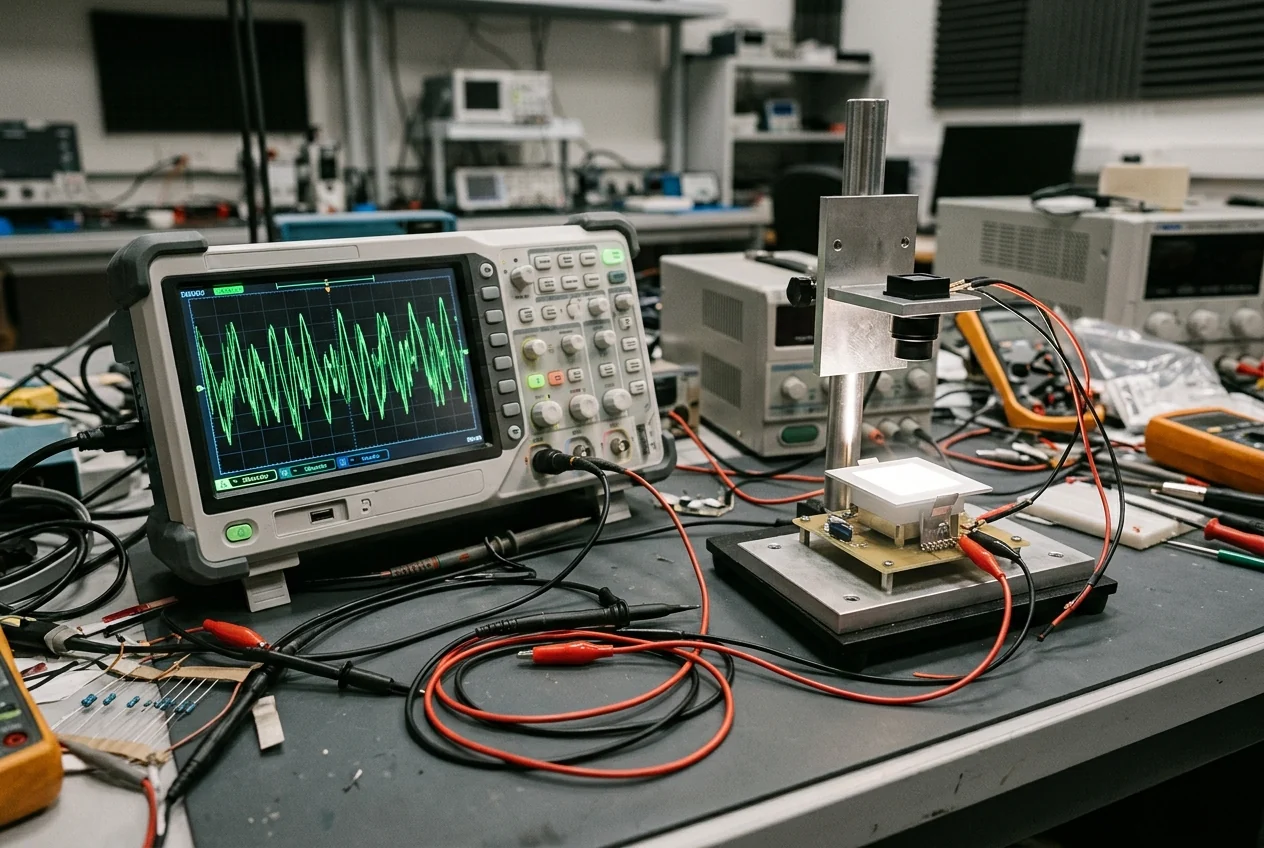
Flicker is the rapid, periodic variation in light output from a luminaire caused by the AC power supply driving the LEDs. Unlike incandescent lamps that had thermal inertia to smooth out fluctuations, LEDs respond almost instantaneously to current changes, making them susceptible to visible and invisible flicker. Flicker effects fall into three categories: • Visible flicker (<80 Hz): Direct perception of light pulsing — causes headaches, eye strain, and is unacceptable. • Stroboscopic effect (80–2000 Hz): Not directly visible but causes moving objects to appear frozen or stuttering — dangerous in industrial settings with rotating machinery. • Phantom array (ghosting): Perceived when eyes move rapidly across a flickering source — causes multiple images of the source.
Flicker Metrics Explained
| 0 | 1 | 2 | 3 |
|---|---|---|---|
| Flicker Percent (Mod%) | IEEE 1789 | Depth of modulation (peak-to-peak/avg) | < 8% at 100Hz |
| Flicker Index | IEEE 1789 | Area-based measure of waveform asymmetry | < 0.1 for low risk |
| PstLM | IEC/TR 61547-1 | Short-term flicker severity (direct perception) | ≤ 1.0 (WELL: ≤ 1.0) |
| SVM | IEC/TR 63158, CIE TN 006 | Stroboscopic visibility measure | ≤ 1.0 (WELL: ≤ 1.0) |
| IES TM-39-25 Rating | ANSI/IES TM-39 | Overall temporal light modulation assessment | Better or Best preferred |
Health & Safety Impacts
Flicker is not merely an annoyance — it has documented health and safety consequences: • Headaches and migraines: Studies show 100Hz flicker (common with poor LED drivers on 50Hz mains) triggers headaches in susceptible individuals, affecting up to 10% of the population. • Epileptic seizures: Visible flicker below 65Hz can trigger photosensitive epilepsy in 1 in 4,000 people. • Eye strain and fatigue: Subclinical flicker (not consciously perceived) causes increased eye strain during sustained visual tasks like reading and computer work. • Industrial safety: Stroboscopic effects can make rotating machinery appear stationary — a serious safety hazard. SVM ≤ 1.0 is required where rotating parts are visible. • Camera interference: Flickering lights cause banding and rolling artifacts in video recording — critical for broadcast studios, conference rooms, and retail with surveillance.
What Causes Flicker in LED Systems?
The primary cause is the LED driver. LED chips produce light proportional to current — if the driver delivers pulsing current, the LEDs flicker. • Cheap drivers: Simple bridge rectifiers produce 100Hz ripple (on 50Hz mains). This creates visible or near-visible flicker — the most common quality issue. • Dimming: Phase-cut dimmers (leading or trailing edge) can introduce severe flicker at low dimming levels if the driver is not compatible. This is the #1 complaint in residential and hospitality projects. • DALI/0-10V dimming: Digital dimming protocols don't inherently cause flicker, but poor-quality constant-current drivers may increase ripple at low output. • PWM dimming: Pulse-Width Modulation at frequencies below 1,000Hz can cause stroboscopic effects. Good PWM drivers operate at ≥3,000Hz.
IES TM-39-25 — The New Standard
ANSI/IES TM-39-25 introduces a standardized method for evaluating and reporting Temporal Light Modulation (TLM) in luminaires. It replaces ad-hoc testing with a formal assessment covering both flicker and stroboscopic effects, rating products from 'Minimum' to 'Better' to 'Best'. Specifiers should request TM-39 ratings from manufacturers, especially for healthcare, office, and industrial applications.