
AI in Lighting Design — Generative Design, Optimization & Visualization
How artificial intelligence is transforming lighting specification, layout optimization, and design visualization.
AI Is Reshaping Lighting Design
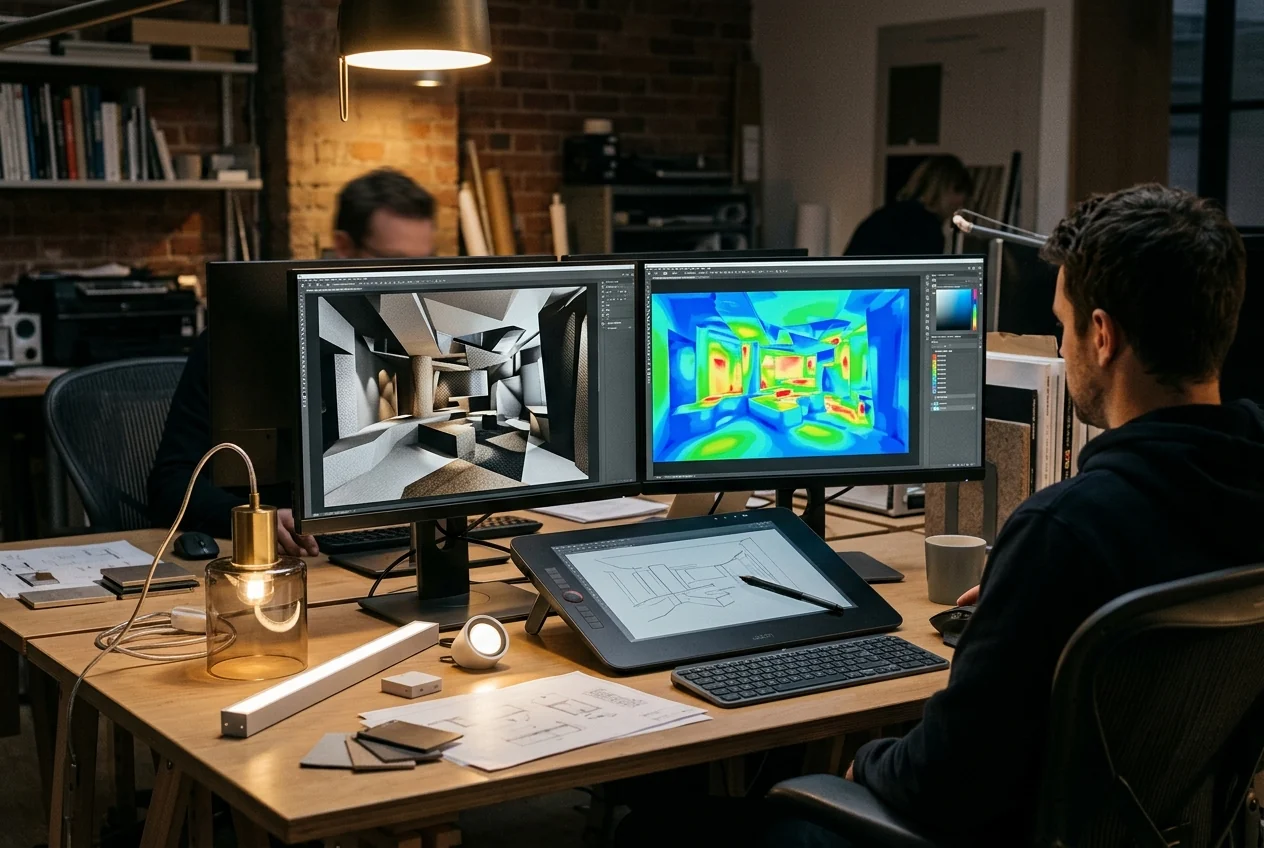
Artificial intelligence is entering the lighting design workflow in three key areas: 1. Visualization: AI image generation tools can create photorealistic lighting scenes from text prompts, allowing designers to explore concepts before detailed calculations. IALD's 2025 conference featured dedicated sessions on AI as a 'design partner' — using prompts describing lighting subjects (cove, pendant, track head), contexts (time of day, weather), and styles (cinematic, atmospheric) to generate ideation images. 2. Layout Optimization: AI algorithms can evaluate thousands of luminaire placement configurations to find optimal solutions that balance illuminance, uniformity, energy efficiency, and cost. What would take a designer hours of iteration, AI can optimize in seconds. 3. Predictive Analysis: Machine learning models trained on building performance data can predict optimal control strategies, maintenance schedules, and energy consumption patterns before a building is occupied.
AI Tools for Lighting Professionals
Current AI applications in lighting: • DIALux AI Assist: Emerging features for automatic luminaire selection and layout suggestion based on room geometry and target standards. • Generative design plugins: Tools that optimize luminaire spacing, aiming angles, and quantities to meet specific illuminance and uniformity targets while minimizing installed power. • AI-powered specification: Machine learning models that recommend products based on project requirements, matching application, performance, and budget criteria. • Energy modeling: AI prediction of lighting energy consumption using occupancy patterns, daylight availability, and control strategy optimization. • Defect detection: Computer vision systems that identify installed luminaire faults, alignment issues, and commissioning defects from site photographs. Important: AI is a tool, not a replacement. The creative, subjective, and experiential aspects of lighting design — atmosphere, emotion, architectural integration — remain fundamentally human skills. AI excels at the quantitative (calculations, optimization) while designers excel at the qualitative (experience, aesthetics, narrative).
AI Visualization in Practice
A lighting designer can prompt: 'Warm cove lighting in a luxury hotel corridor with timber ceiling, evening ambiance, soft wall wash' and receive a realistic visualization in seconds. This dramatically accelerates the concept and client communication phases. However, these images are artistic interpretations — they don't replace photometric calculations or standards compliance verification. Use AI for inspiration and communication; use engineering tools (DIALux, Relux) for design validation.