
Back to Academy
Technical EngineeringElectrical Design
Load Balancing in Lighting Circuits
Distributing electrical load evenly across phases for efficiency and safety.
5 min LEDWORLD Technical Team 256 views
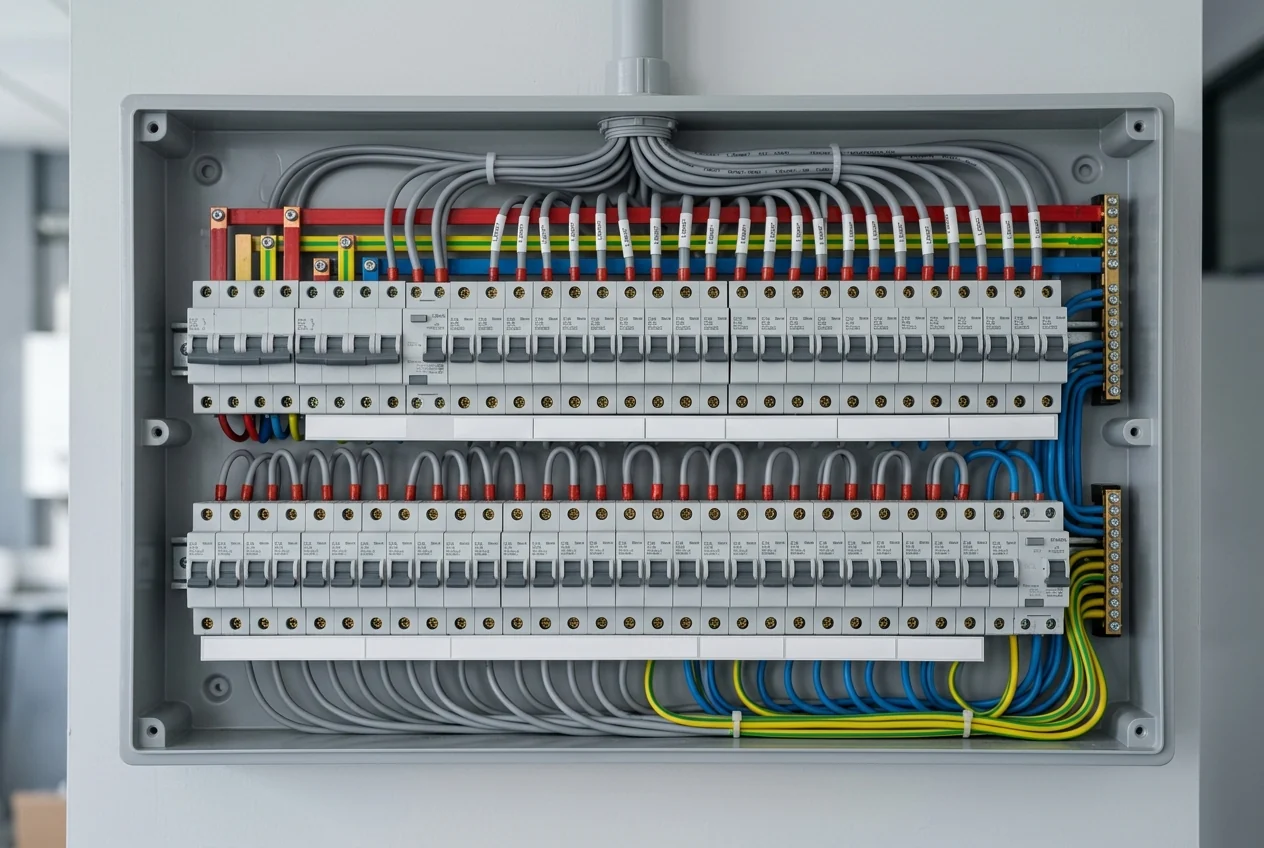
The Rule
Keep phase imbalance below 10–15%. If Phase A carries 5kW, Phase B and C should each carry 4.25–5.75kW. Greater than 15% imbalance causes neutral current, wasted energy, and potential breaker trips.
Why Balance Matters
In a three-phase system, balanced loads cancel out in the neutral conductor, resulting in near-zero neutral current. Unbalanced loads create neutral current that generates heat, wastes energy, and can cause nuisance tripping. In extreme cases, an overloaded neutral can be a fire risk.
Circuit Planning Example
| circuit | load w | phase | breaker |
|---|---|---|---|
| C1 — Lobby ambient | 1,200W | L1 | 10A |
| C2 — Lobby accent | 800W | L2 | 6A |
| C3 — Corridor L1-L5 | 600W | L3 | 6A |
| C4 — Corridor L6-L10 | 600W | L1 | 6A |
| C5 — Banquet room | 1,500W | L2 | 10A |
| C6 — Exterior facade | 1,800W | L3 | 10A |
Before You Specify
List all lighting circuits with their wattage
Group circuits by zone and control requirement
Distribute across phases aiming for <10% imbalance
Account for inrush current of LED drivers (2–3× steady state)
Size breakers for inrush, not just steady-state load
Label all circuits clearly on the distribution board schedule
Common Mistakes
Loading all high-wattage circuits on one phase — massive imbalance
Ignoring LED driver inrush current — causes nuisance tripping at startup
Not accounting for dimming — some dimmers change power factor
Oversizing breakers to 'solve' tripping — masks underlying issues
Related Tools
Frequently Asked Questions
Related Articles
load balancingthree-phasecircuitbreakerelectrical