
Lighting for Aging Populations — Visual Needs & Design Solutions
How the aging eye changes and what it means for lighting design in senior living, healthcare, and public spaces.
How Aging Affects Vision
By age 60, the human eye transmits only about 33% of the light it did at age 20. By 80, this drops to approximately 15-20%. This has profound implications for lighting design: • Reduced light reaching the retina: Older adults need 2-3x more light for the same visual task performance. • Increased glare sensitivity: The yellowing lens scatters light, making older adults more susceptible to both disability and discomfort glare. • Reduced contrast sensitivity: Fine detail discrimination declines — higher luminance contrast is needed. • Slower adaptation: Transitioning between light and dark takes significantly longer — abrupt changes between bright and dim areas are dangerous. • Reduced color discrimination: Blue-yellow discrimination declines first, making warm-vs-cool differentiation harder. • Reduced melanopic sensitivity: Less light reaches ipRGCs, requiring higher m-EDI for circadian entrainment.
Age-Adjusted Illuminance Recommendations
| 0 | 1 | 2 | 3 |
|---|---|---|---|
| Living room / lounge | 200 lux | 400 lux | 600 lux |
| Reading / close work | 500 lux | 750-1000 lux | 1000-1500 lux |
| Corridor / circulation | 100 lux | 200 lux | 300 lux |
| Stairway | 150 lux | 300 lux | 400 lux |
| Bathroom | 200 lux | 400 lux | 500 lux |
| Kitchen / food preparation | 500 lux | 750 lux | 1000 lux |
| Entrance / transition zone | 300 lux | 500 lux | 800 lux |
Design Principles for Aging-Friendly Lighting
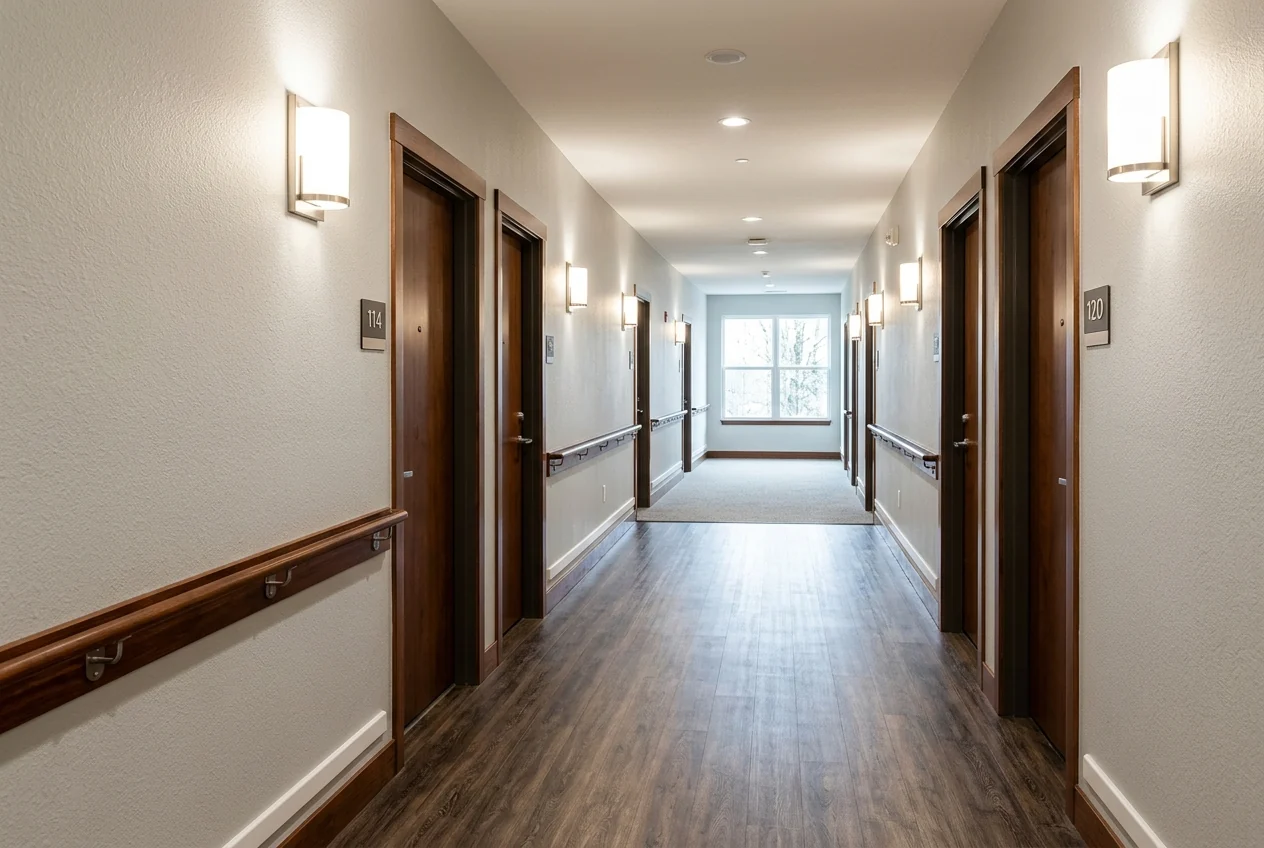
1. Increase Light Levels Without Increasing Glare: Use indirect and diffused lighting. Wall washing and cove lighting provide high ambient levels without exposed sources. Avoid exposed lamps, clear reflectors, and high-brightness point sources. 2. Maximize Contrast: Light-colored walls with contrasting floor edges, door frames in contrasting tones, and task surfaces brighter than surroundings all improve navigability. Edge lighting on stairs (minimum 150 lux on treads, with visible nosing strips) is critical for fall prevention. 3. Eliminate Abrupt Transitions: Gradual dimming between zones prevents the dangerous 'blindness' that occurs when aging eyes move between bright and dark areas. A 3:1 maximum ratio between adjacent zones is recommended. 4. Night Lighting: Low-level amber pathway lighting (< 5 lux, warm CCT < 2200K) for nighttime navigation to bathrooms without disrupting sleep. 5. Circadian Support: Bright, melanopic-rich light during the day (≥ 200 m-EDI at eye level) helps maintain sleep-wake cycles, which deteriorate with age. Tunable white systems programmed for high CCT mornings are especially beneficial in memory care and dementia units.