Lighting Carbon Footprint & Lifecycle Assessment
Measuring and reducing the total environmental impact of lighting from manufacturing to end-of-life.
Beyond Operational Energy
Traditionally, sustainability in lighting focused exclusively on operational energy — watts consumed during use. But as LED efficiency has dramatically reduced operational energy, embodied carbon (the CO2 emitted during manufacturing, transport, and disposal) represents an increasing proportion of total lifecycle impact. For a modern LED luminaire: • Operational energy: 70-85% of lifecycle carbon (at 10-year use, average grid mix). • Embodied carbon: 15-30% of lifecycle carbon (aluminum housings, electronics, rare earth phosphors). • End-of-life: < 5% (recycling, disposal). As grid electricity decarbonizes (solar, wind), embodied carbon's share will increase further — making material choices, longevity, and recyclability more important.
Lifecycle Assessment (LCA) Basics
A lighting LCA evaluates environmental impact across four stages: 1. Manufacturing (A1-A3): Raw material extraction, component manufacturing, luminaire assembly. Aluminum housing production is the largest embodied carbon contributor. 2. Transport & Installation (A4-A5): Shipping, site logistics, installation energy. Local manufacturing reduces this significantly. 3. Use Phase (B1-B7): Electricity consumption over the design life, maintenance (lamp/driver replacement), and cleaning. 4. End of Life (C1-C4): Demolition, transport to recycling/disposal, recycling recovery, waste treatment. Environmental Product Declarations (EPDs) provide standardized LCA data for luminaires per EN 15804 / ISO 14025. Specifying products with EPDs enables quantified comparison of environmental impact.
Circular Economy in Lighting
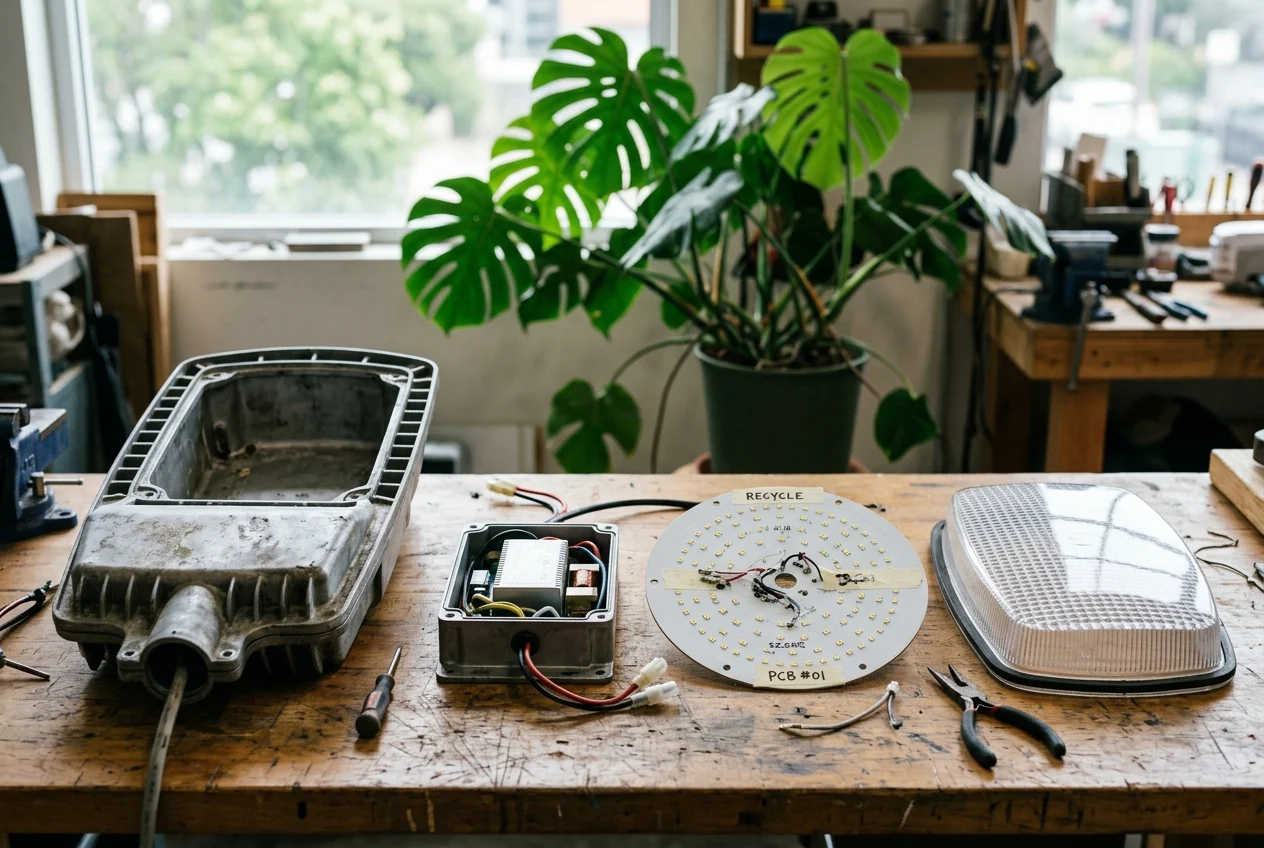
Circular economy principles applied to lighting: • Design for disassembly: Luminaires with replaceable LED modules and drivers extend product life without full replacement. • Modular components: Standardized driver compartments, optical cassettes, and housing systems. • Material recovery: Aluminum (highly recyclable), electronics (WEEE compliance), plastics (recyclable polymers). • As-a-Service: Lighting-as-a-Service (LaaS) models where manufacturers retain ownership and responsibility for lifecycle management, including takeback and recycling.