
Surge Protection for LED Systems
Protecting LED investments from voltage spikes, lightning, and power grid transients.
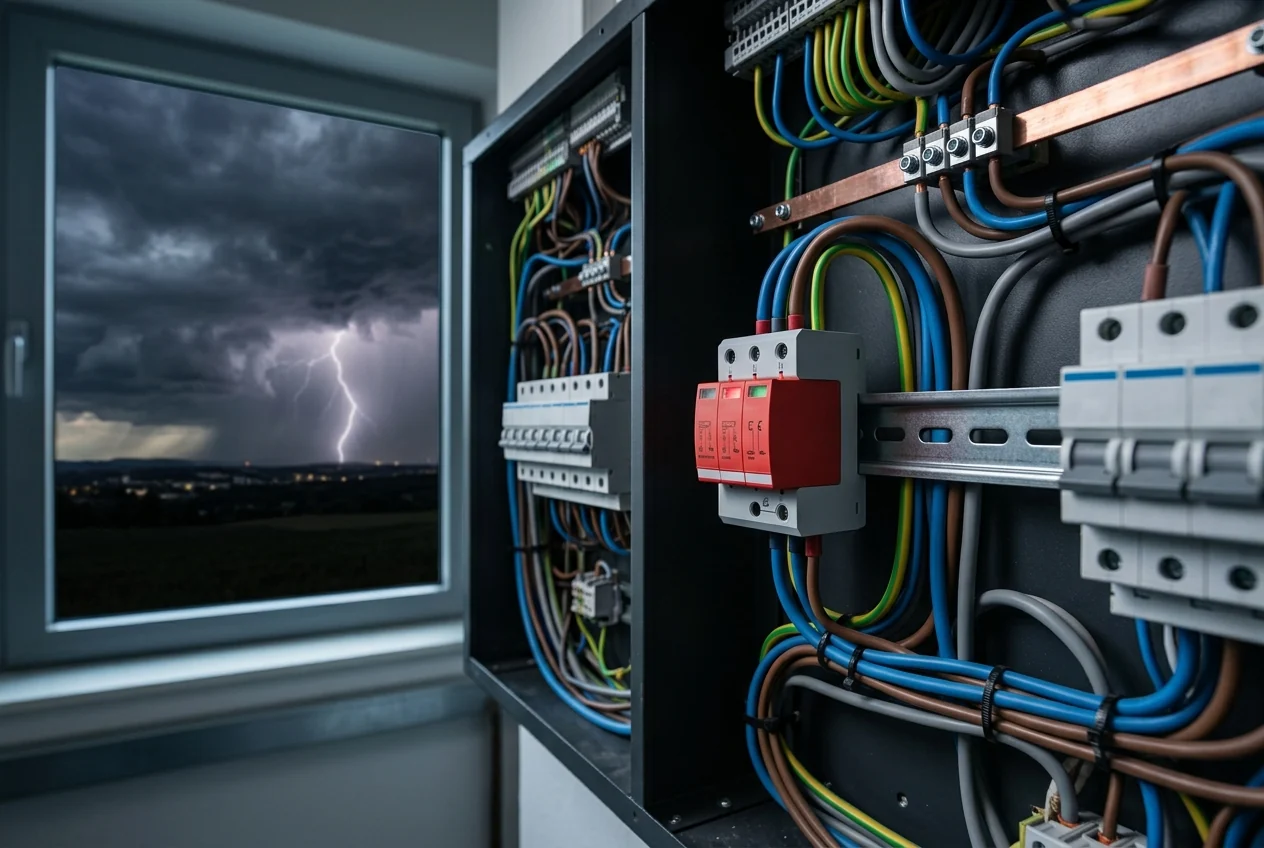
Why LEDs Are Vulnerable to Surges
LED drivers contain sensitive semiconductor components that are far more vulnerable to voltage transients than traditional magnetic ballasts. A single surge event can destroy an LED driver instantly, while repeated lower-level transients degrade components over time, causing premature failure. Common surge sources: • Lightning (direct and indirect): The primary threat in GCC, particularly for outdoor installations. Even lightning strikes within 1km can induce damaging transients on power lines. • Grid switching: Utility load switching, transformer tap changes, and capacitor bank switching create transients up to 6kV. • Internal switching: Large motor starts, elevator motors, HVAC compressors, and even other lighting circuits switching on/off generate internal transients. • Electrostatic discharge: In low-humidity environments (rare in GCC but relevant for data centers and clean rooms).
Surge Protection Device (SPD) Ratings
| 0 | 1 | 2 | 3 |
|---|---|---|---|
| Type 1 (Class I) | Main distribution board | Direct lightning strike | 25-100 kA (10/350μs) |
| Type 2 (Class II) | Sub-distribution board | Indirect lightning, switching | 20-40 kA (8/20μs) |
| Type 3 (Class III) | At the luminaire/driver | Residual transients | 6-10 kA (8/20μs) |
| Integral (in-driver) | Inside the LED driver | Last line of defense | 2-6 kA (8/20μs) |
Installation Best Practices
For comprehensive LED surge protection: 1. Cascaded protection: Install Type 1 at the main switchboard, Type 2 at sub-distribution, and Type 3 at lighting distribution boards. This 'zones of protection' approach progressively clamps transients. 2. SPD lead length: Keep connection leads to SPDs as short as possible (< 50cm total) — long leads add inductance that reduces SPD effectiveness. 3. Outdoor circuits: All outdoor LED circuits must have dedicated Type 2 SPDs at the sub-board PLUS integral or Type 3 protection at the luminaire. Outdoor fixtures with long cable runs (> 30m) are especially vulnerable. 4. Coordination: Ensure SPDs are coordinated so Type 1 operates first for large events and Type 3 operates for smaller residual transients. 5. LED drivers: Specify drivers with integral surge protection rated ≥ 6kV (L-N) and ≥ 10kV (L-PE) for outdoor, ≥ 4kV (L-N) for indoor. 6. Grounding: Proper earthing is essential — SPDs shunt transients to ground. Poor earthing negates SPD effectiveness entirely.
GCC Surge Considerations
The GCC experiences significant lightning activity (particularly UAE, Oman, and Saudi Arabia during convective storms) and grid instability in developing areas. For outdoor LED installations, the minimum recommendation is: 10kV surge-rated drivers, Type 2 SPDs at sub-distribution, and Type 3 SPDs at every outdoor lighting pole feeder pillar. For premium projects, specify 20kV-rated drivers and dedicated per-pole SPDs.