
Li-Fi Technology — Data Transmission via Light
How visible light communication enables high-speed data transfer, indoor positioning, and secure connectivity.
What Is Li-Fi?
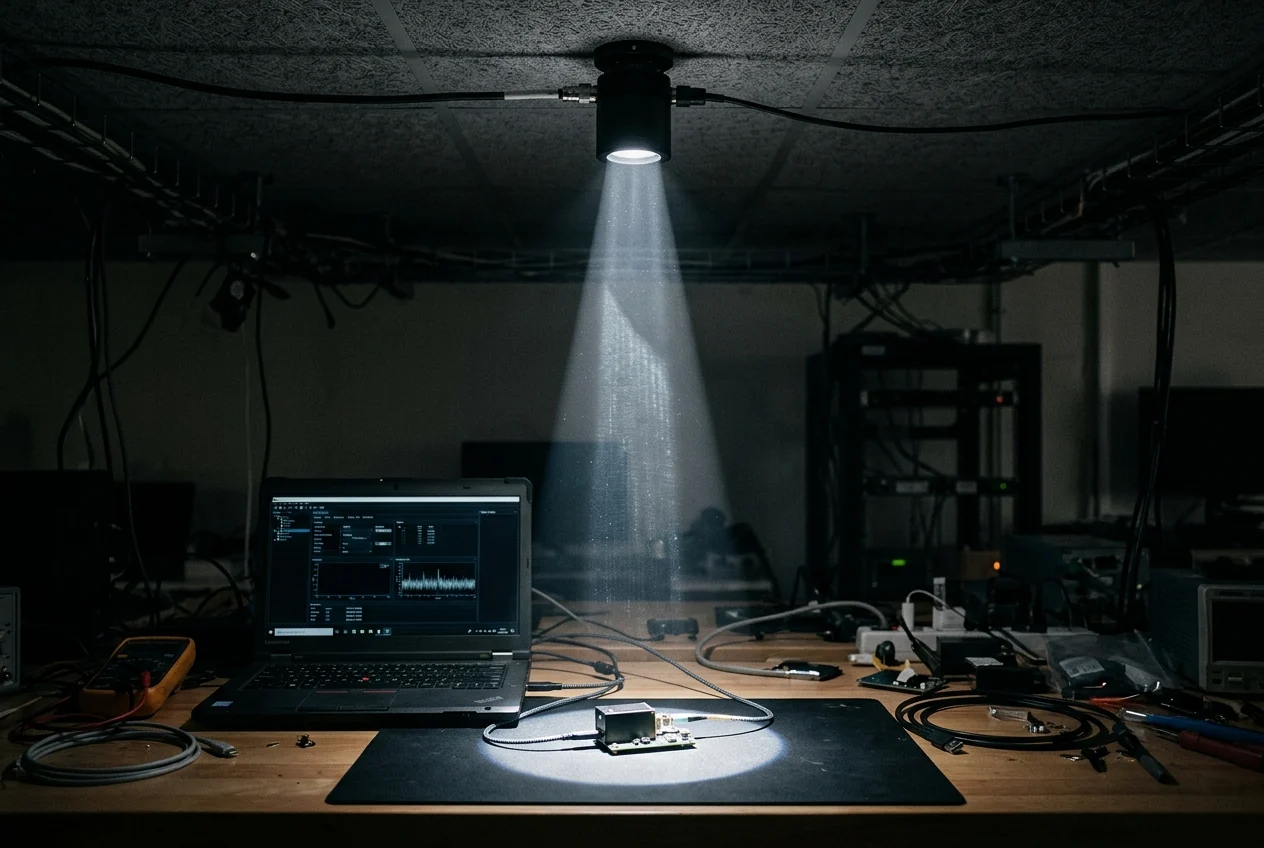
Li-Fi (Light Fidelity) is a wireless communication technology that uses visible light, ultraviolet, or infrared electromagnetic spectrum to transmit data. LED luminaires act as the transmission medium, modulating light intensity at frequencies imperceptible to the human eye (millions of times per second) to encode data. Key advantages over Wi-Fi: • Speed: Lab demonstrations have achieved up to 224 Gbps. Commercial systems currently deliver 100+ Mbps — competitive with Wi-Fi. • Security: Light doesn't penetrate walls, making Li-Fi inherently more secure against eavesdropping. • No RF interference: Ideal for hospitals, aircraft, and industrial environments where radio frequency signals are problematic. • Spectrum capacity: The visible light spectrum is 10,000x wider than the radio frequency spectrum, offering massive bandwidth potential. • Indoor positioning: Li-Fi-enabled luminaires can provide sub-meter indoor positioning accuracy — valuable for retail analytics, warehouse management, and navigation.
How Li-Fi Works with LED Lighting
Li-Fi retrofits existing LED lighting infrastructure with specialized driver modules that modulate the LED output. The modulation frequency (MHz range) is far too fast for the human eye to detect — the room appears normally lit. A photosensor receiver (typically a USB dongle or integrated into a laptop/phone) decodes the light signal. Uplink communication returns data via infrared or a separate low-power channel. Current commercial Li-Fi systems (Signify Trulifi, pureLiFi) integrate into standard ceiling luminaire form factors, operating alongside normal illumination functions.
Current Limitations
Li-Fi requires line-of-sight or at least line-of-reflection between the luminaire and receiver. It doesn't work through walls (which is also its security advantage). Coverage area per luminaire is limited to its beam spread. Outdoor use is limited by ambient light interference. The technology is maturing but not yet a wholesale Wi-Fi replacement — it's best used as a complementary technology in specific high-value applications.