
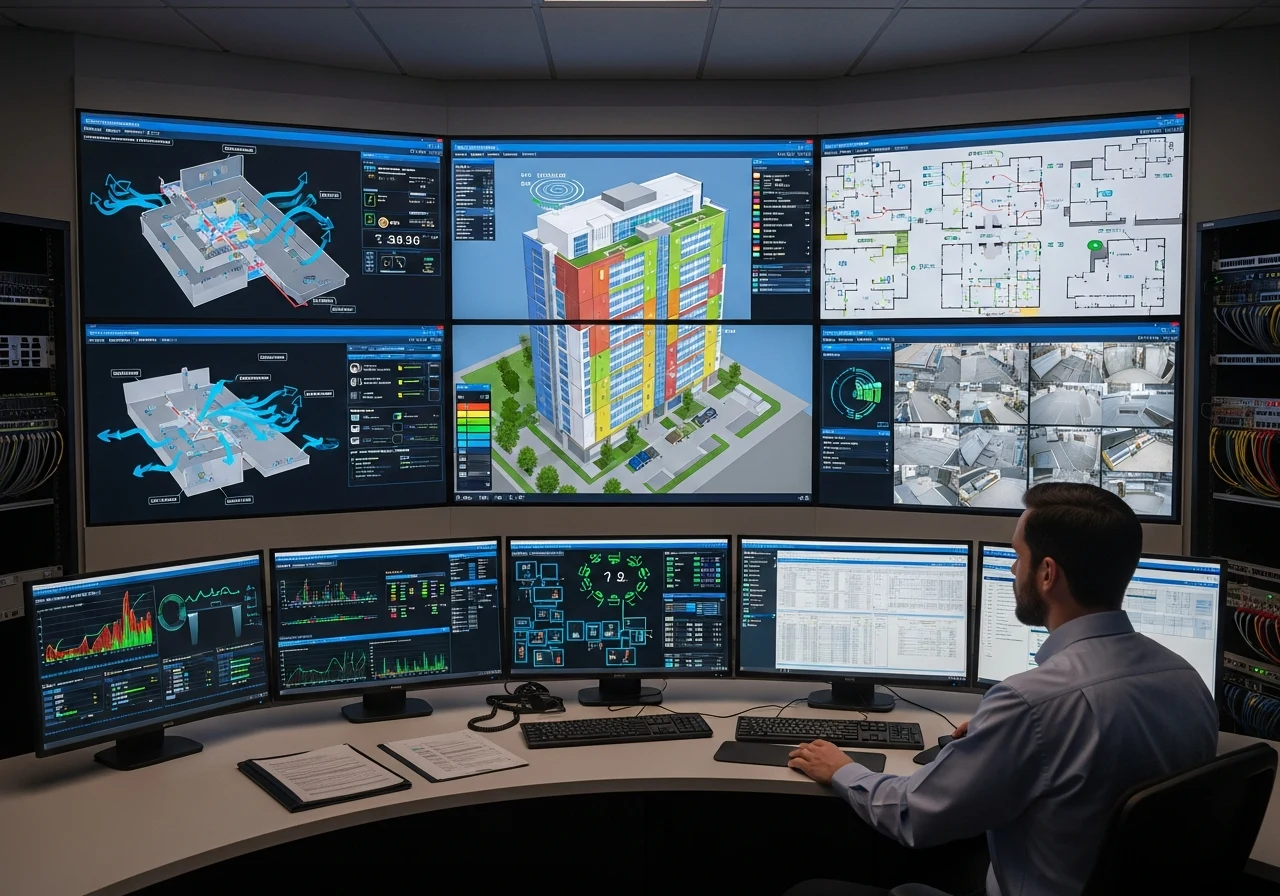
LIGHTING'S ROLE IN BMS
Building Management Systems (BMS) provide centralized supervision and control of facility operations — HVAC, lighting, security, fire systems, and energy monitoring. Lighting integration enables coordinated scheduling, demand response, and unified energy reporting across the entire building.
Modern lighting systems connect to BMS via standard protocols (BACnet, Modbus) through dedicated gateways. This architecture maintains lighting-specific control layers while enabling high-level coordination and comprehensive facility management.
LAYERED ARCHITECTURE
User Interface
Human interaction point
Touchscreens, apps, keypads, voice
Automation Layer
High-level orchestration
BMS, KNX, GRMS
Lighting Control Layer
Protocol-specific control
DALI, DMX, 0-10V
Fixture & Driver Layer
Physical hardware
LED drivers, fixtures, sensors
This layered approach prevents overloading any single system and maintains reliability across all control functions.
INTEGRATION PROTOCOLS
BACnet
ISO 16484-5Object-oriented architecture with standardized data points. Most common protocol for BMS integration.
Modbus
Industry (1979)Simple register-based communication. Lower cost than BACnet. Widely supported by industrial equipment.
MQTT
OASISLightweight publish/subscribe protocol. Ideal for IoT and machine-to-machine communication.
HTTP/REST
WebUbiquitous web standard. Flexible data formats (JSON, XML). Highly scalable for web-based services.
BACNET OBJECTS FOR LIGHTING
Binary Output (BO)
On/off control of lighting circuits
Analog Output (AO)
Dimming level control (0-100%)
Binary Input (BI)
Occupancy sensor status
Analog Input (AI)
Light level, energy consumption readings
MODBUS REGISTERS
Holding Registers
Dimming levels, switching commands
Input Registers
Status readings, measurements
Coils
Binary outputs for switching
Discrete Inputs
Binary status readings
COMMON BMS PLATFORMS
Siemens Desigo
Enterprise building management with comprehensive analytics
Johnson Controls Metasys
Integrated building automation and security
Schneider EcoStruxure
IoT-enabled building and energy management
Honeywell Niagara
Open framework for building integration
INTEGRATION USE CASES
ENERGY ANALYTICS
BMS integration enables detailed energy monitoring and reporting for green building certifications (LEED, WELL, Estidama) and operational optimization.
KEY ADVANTAGES
CRITICAL INTEGRATION PRINCIPLES
• Never force BMS to directly control individual lighting fixtures
• Use proper gateway architecture to maintain system independence
• Lighting systems maintain dedicated control layers for precision
• BMS coordinates behavior without replacing lighting protocols
• Energy data flows to BMS via standard gateways (BACnet, Modbus, OPC)
Proper gateway architecture ensures that lighting systems maintain independent operation while enabling high-level BMS coordination. This prevents single points of failure and ensures reliable lighting regardless of BMS status.
TYPICAL INTEGRATION ARCHITECTURE
BMS Server
Central Supervision
BACnet/Modbus Gateway
Protocol Translation
DALI Controller
Lighting Control
Fixtures
Physical Devices
Data flow: Status, energy, alarms → BMS | Commands, schedules → Lighting
NEED BMS INTEGRATION?
Our controls team designs and implements BACnet/Modbus integration for seamless BMS connectivity across any facility type.