
Tunable White & Dynamic CCT Scheduling
How to implement color temperature automation in offices, healthcare, and education for circadian and visual comfort.
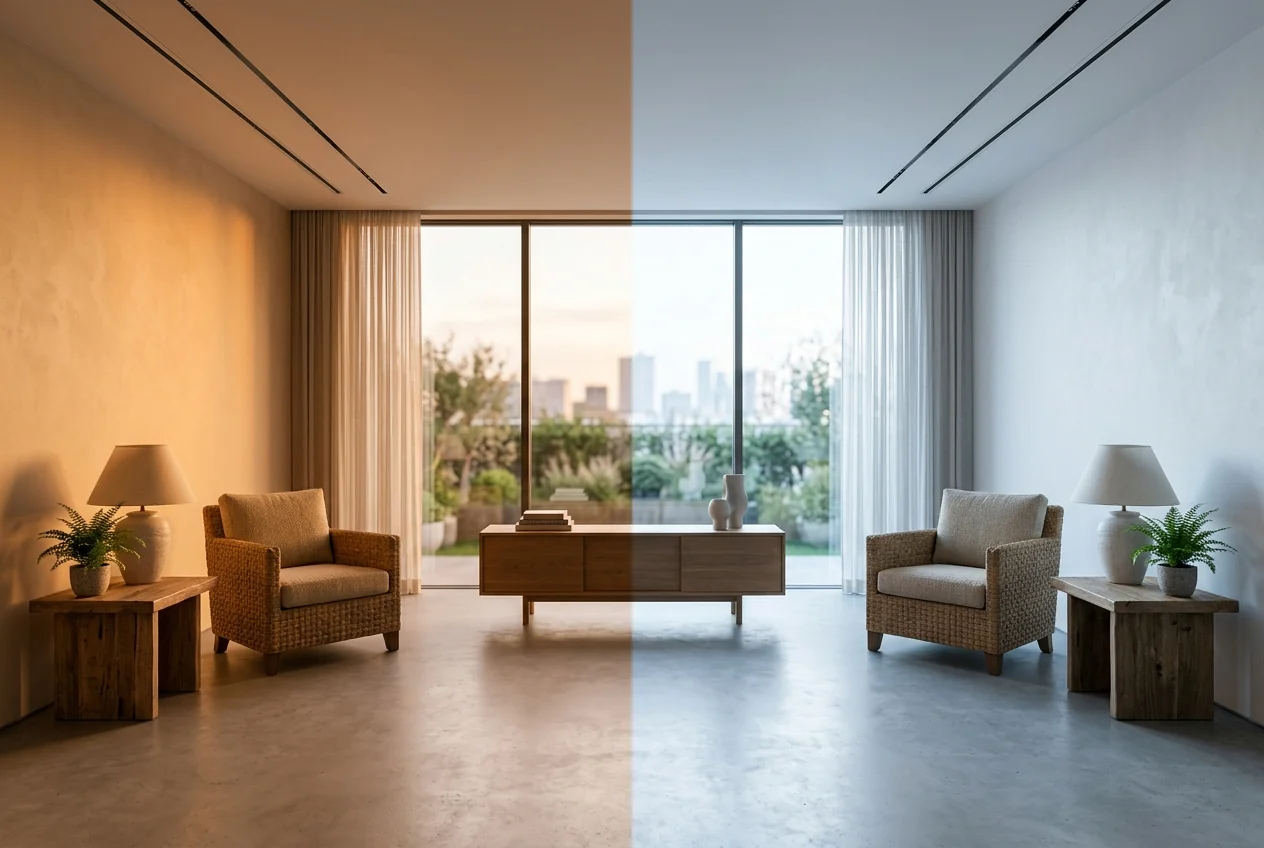
What Is Tunable White?
Tunable white (TW) luminaires contain multiple LED arrays — typically warm-white (2700K) and cool-white (6500K) — that can be mixed in varying proportions to produce any CCT within their range. Combined with dimming, this gives designers full control over both intensity and color temperature throughout the day. This technology is the practical enabler of circadian lighting design, WELL Building Standard L03 compliance, and human-centric lighting (HCL) strategies. It allows a single luminaire system to provide energizing cool-white light in the morning and relaxing warm-white light in the evening.
Tunable White Control Protocols
| 0 | 1 | 2 | 3 |
|---|---|---|---|
| DALI DT8 (Tc) | Dedicated CCT channel via DALI bus | Industry standard, interoperable, reliable | Commercial offices, hospitals |
| DALI DT6 (dual channel) | Two independent dim channels (warm/cool) | Works with any DALI-2 controller | Retrofit, cost-sensitive projects |
| Bluetooth Mesh (Casambi, Silvair) | Wireless app/gateway control | No extra wiring, easy commissioning | Hospitality, retail, residential |
| Zigbee 3.0 | Wireless mesh network | Interoperable IoT ecosystem | Smart buildings, large campuses |
| KNX with DALI gateway | Room-level scheduling via BMS | Full building integration | Premium commercial, hospitals |
| 0-10V (dual) | Two analog dim circuits | Simple, low cost | Basic TW applications |
CCT Scheduling Strategies
A CCT schedule defines how color temperature and intensity change throughout the day. The goal is to align indoor lighting with the natural solar cycle. Typical Office Schedule: • 7:00-9:00 AM: 5000K at 100% — bright, cool light for morning alertness and circadian entrainment. • 9:00-12:00 PM: 4500K at 100% — sustain focus and energy. • 12:00-2:00 PM: 4000K at 90% — slight warm shift during post-lunch dip. • 2:00-5:00 PM: 3500K at 85% — transition toward afternoon. • 5:00-7:00 PM: 3000K at 60% — warm, relaxing tone for end of day. • After 7:00 PM: 2700K at 40% — minimal circadian disruption for late workers. Healthcare Schedule: • Day: 4000-5000K at clinical levels — supports staff alertness and patient assessment. • Evening: 3000K — comfort for patients, reduced circadian disruption. • Night: 2700K amber at minimum levels — allows wayfinding without suppressing melatonin. Education Schedule: • Morning classes: 5000K — maximizes alertness for learning. • Afternoon: 4000K — sustained attention. • Exam conditions: 4000K at 500 lux — optimal for concentration without fatigue.
Warm Dim vs Tunable White
Warm Dim simulates incandescent behavior — as you dim, the CCT drops (e.g., 3000K at 100% → 1800K at 10%). It's ideal for hospitality and restaurants where dimming should feel natural and atmospheric. Tunable White gives independent control of CCT and intensity — you can have 5000K at 50% or 2700K at 100%. It's essential for circadian applications where you need specific CCT at specific intensity levels.