
Residential Lighting Design — A Room-by-Room Guide
Creating beautiful, functional home lighting: layered design, circuit planning, and scene creation for every room.
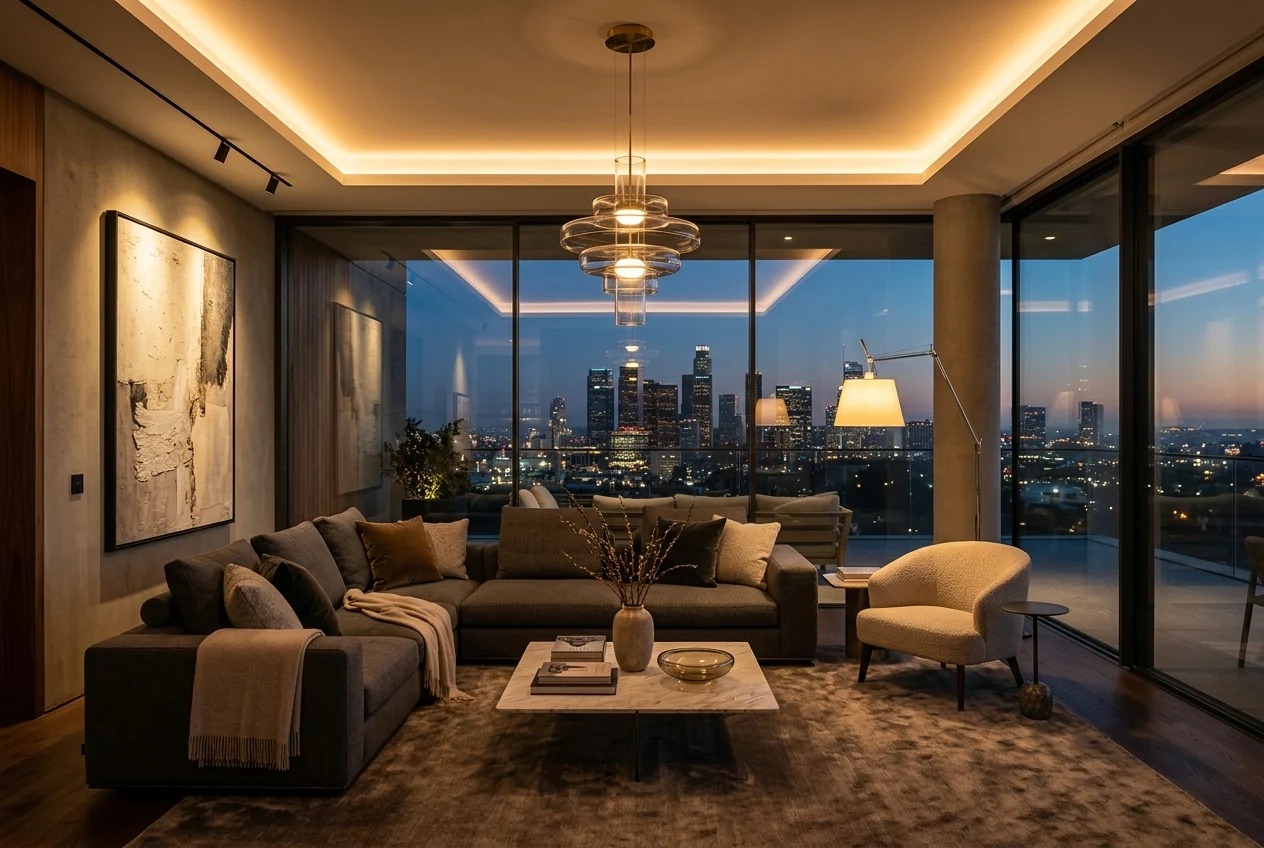
The Three Layers of Residential Lighting
Every room needs three layers of light working in harmony: 1. Ambient (General): The base layer that fills the room. Typically cove lighting, recessed downlights on wide beam, or indirect pendants. Target: 150-300 lux general, dimmable. 2. Task: Focused light where activities happen. Under-cabinet kitchen lighting, reading lights, vanity mirror lighting, desk lamps. Target: 300-750 lux on the task surface. 3. Accent: The architectural and decorative layer that creates atmosphere. Artwork spots, shelf lighting, architectural wall washes, decorative pendants. Target: 3:1 to 5:1 ratio over ambient. The magic of residential lighting design is in the balance between these layers — and giving homeowners control over each through dimming and scene presets.
Room-by-Room Lighting Guide
| 0 | 1 | 2 | 3 | 4 | 5 |
|---|---|---|---|---|---|
| Living room | Cove / indirect 150-200 lux | Reading spots 500 lux | Artwork spots, shelf LED | 2700-3000K | Multiple circuits + dimming for scenes |
| Kitchen | Downlights 300 lux | Under-cabinet 500-750 lux | Pendant over island | 3000-4000K | Task lighting on counters is critical |
| Master bedroom | Cove / indirect 100-150 lux | Bedside reading 300 lux | Closet LED, artwork | 2700K (warm dim) | Blackout capability + amber night light |
| Bathroom | Ceiling downlights 300 lux | Vanity mirror side-lit 400 lux | Niche/shelf LED | 3000-4000K | Side-lit mirror — never downlight-only on face |
| Dining room | None or minimal | Pendant 200-300 lux on table | Buffet/display accent | 2700K dimmed | Pendant 600-750mm above table |
| Home office | Indirect 200 lux | Desk task 500 lux | Shelf/bookcase | 4000K (daytime) | Tunable white for productivity + evening |
| Entrance hall | Pendant/chandelier 200 lux | — | Wall wash, niche | 2700-3000K | First impression — layer decorative + ambient |
| Stairway | Step lights 100-150 lux | — | Handrail/cove | 2700-3000K | Safety: illuminate treads, not risers |
| Garden/terrace | Bollards/post 20-50 lux | BBQ/outdoor kitchen 300 lux | Tree uplighting, facade wash | 2700K | IP65+, warm for evening atmosphere |
Switch and Circuit Planning
Residential lighting design fails when the control infrastructure is wrong. Key principles: • Separate circuits for each layer: Ambient, task, and accent on independent circuits so each can be dimmed or switched independently. • Scene presets: A 4-button scene panel at the room entry provides one-touch access to 'Entertain', 'Relax', 'Movie', 'All On' scenes. Far more user-friendly than individual dimmer switches. • Two-way switching: Entry/exit control for all circulation areas. • Bedroom master switch: A single button at the bedside that turns off everything except night lighting. • Bathroom automation: Occupancy sensor + ambient light sensor for night visits (dim warm light) vs daytime use (full brightness). • Outdoor automation: Dusk-to-dawn photocell + timer for landscape lighting. Motion sensors for security areas.
Bathroom Mirror Lighting
The #1 residential lighting mistake: a single recessed downlight above the bathroom mirror. This creates unflattering shadows under the brow and chin. Correct approach: vertically-mounted LED strips or sconces on BOTH sides of the mirror at face height, providing shadowless, even illumination for grooming. Temperature: 3000-4000K at CRI 90+ for accurate color rendering.