
EN 12464-2 — Outdoor Workplace Lighting Standards
The 2024/2025 revised standard for lighting outdoor work areas, from construction sites to loading docks.
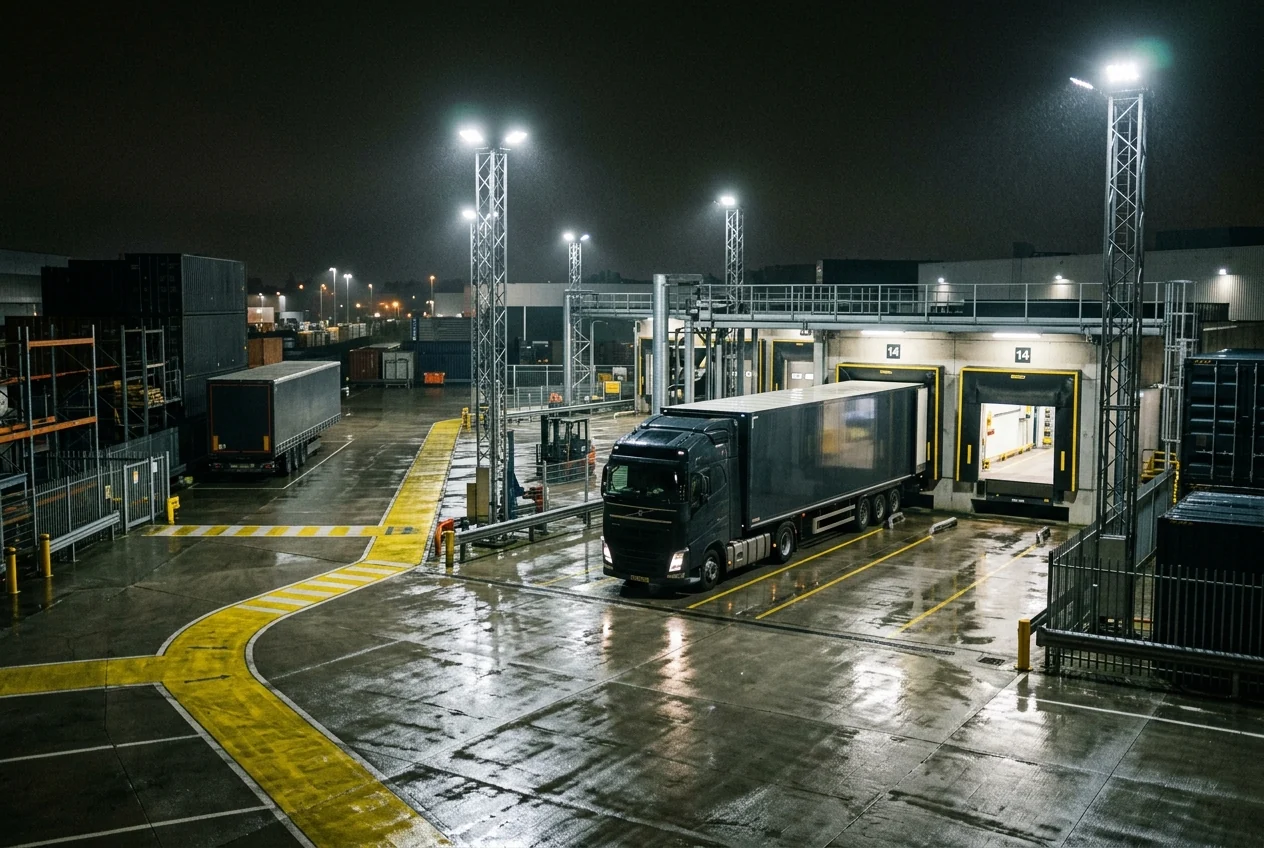
EN 12464-2:2024 — What Changed
EN 12464-2 'Light and lighting — Lighting of work places — Part 2: Outdoor work places' was revised in 2024/2025 with significant updates. The standard now covers all outdoor areas where work is performed, including construction sites, loading bays, petrol stations, car parks, railways, and waterway areas. Key changes in the revision include: • Updated terminology aligning with CIE standards for the luminous environment. • New emphasis on luminance distribution and directionality of light. • Expanded guidance on flicker, stroboscopic effects, and color rendering. • Clearer requirements for reduced lighting levels under certain conditions. • Integration of energy efficiency considerations. • Updated tables for specific task and area illuminance requirements.
Selected Outdoor Illuminance Requirements
| 0 | 1 | 2 | 3 |
|---|---|---|---|
| Pedestrian walkways | 20 | 0.25 | 20 |
| Vehicle traffic areas (low speed) | 20 | 0.25 | 20 |
| Parking — outdoor general | 20 | 0.25 | 20 |
| Loading / unloading bays | 150 | 0.25 | 40 |
| Construction — general site | 20 | 0.25 | 20 |
| Construction — active work areas | 100 | 0.40 | 40 |
| Petrol / fuel stations | 150 | 0.25 | 40 |
| Building exterior entrance | 50 | 0.25 | 40 |
| Emergency assembly points | 20 | 0.25 | 20 |
| Container terminal operations | 30-50 | 0.25 | 20 |
| Outdoor sports (training) | 200-500 | varies | 60-80 |
Glare Control Outdoors
Outdoor glare control is managed through luminaire selection, mounting height, aiming angle, and shielding. The standard specifies maximum luminous intensity values at high angles to prevent glare to workers, drivers, and neighboring areas. For areas near residential zones or roads, additional restrictions apply: • Luminaire intensity above 70° from nadir must be controlled. • Upward Light Output Ratio (ULOR) should be minimized — ideally 0% for dark-sky compliance. • BUG ratings (Backlight, Uplight, Glare) provide a standardized way to classify outdoor fixture performance. In GCC environments, careful glare control at low angles prevents dangerous dazzle for vehicle drivers on adjacent roads.
GCC-Specific Considerations
Outdoor lighting in the GCC faces unique challenges: extreme heat (50°C+) affects LED performance and lifespan, sand and dust reduce fixture output rapidly (plan for MF 0.60-0.70), coastal locations require marine-grade corrosion resistance (IP66/67 minimum), and intense daytime sunlight creates extreme adaptation issues at building entrances (transition lighting at 300+ lux recommended).