
Educational Facility Lighting — Schools, Universities & Libraries
Designing learning environments that support concentration, visual comfort, and student well-being.
Lighting's Impact on Learning
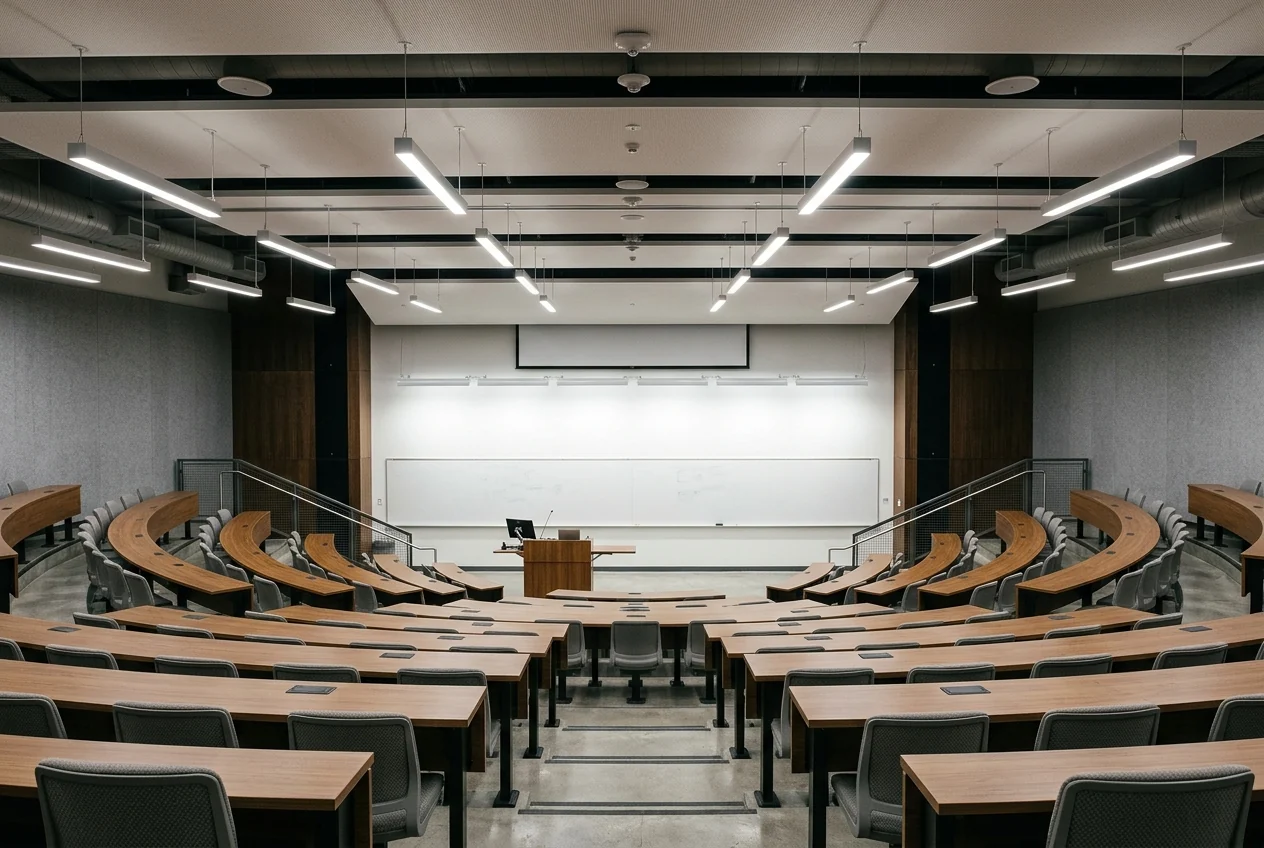
Research consistently shows that well-designed lighting improves student performance by 10-15%. Natural light exposure, appropriate illuminance levels, and reduced glare directly affect concentration, behavior, and academic outcomes. Key requirements for educational lighting (EN 12464-1 / CIBSE LG5): • Classrooms: 300 lux on desks, 500 lux on teaching wall/whiteboard, UGR ≤ 19, U0 ≥ 0.60, CRI ≥ 80. • Lecture halls: 500 lux on desks when writing, dimmable to 300 lux for presentations, UGR ≤ 19. • Libraries — reading areas: 500 lux, U0 ≥ 0.60. Stack areas: 200 lux vertical on shelf faces. • Art studios: 750 lux, CRI ≥ 90 (color-critical work). • Laboratories: 500 lux, CRI ≥ 80, high uniformity for bench work.
Education Illuminance Requirements
| 0 | 1 | 2 | 3 | 4 | 5 |
|---|---|---|---|---|---|
| General classroom | 300 | ≤ 19 | 0.60 | 80 | 500 lux on whiteboard wall |
| Computer lab | 300 | ≤ 19 | 0.60 | 80 | Avoid screen reflections, indirect preferred |
| Art / design studio | 750 | ≤ 19 | 0.70 | 90 | Color-critical — TM-30 Rf ≥ 85 recommended |
| Science laboratory | 500 | ≤ 19 | 0.60 | 80 | Chemical-resistant fixtures, emergency lighting |
| Library reading | 500 | ≤ 19 | 0.60 | 80 | Task lights on tables for flexibility |
| Library stacks | 200 vertical | ≤ 25 | 0.40 | 80 | Vertical illuminance on shelf faces |
| Lecture theatre | 500/300 | ≤ 19 | 0.60 | 80 | Dimmable: 500 writing / 300 presentation |
| Assembly hall | 300 | ≤ 22 | 0.40 | 80 | Stage lighting separate |
| Corridor | 100 | ≤ 25 | 0.40 | 40 | Emergency lighting per EN 1838 |
| Sports hall (school) | 300-500 | ≤ 22 | 0.60 | 60 | Ball visibility, anti-glare |
Circadian Lighting in Schools
Adolescents have delayed circadian rhythms compared to adults — morning bright, blue-enriched light (5000K+) helps counteract this, improving alertness and academic performance in morning classes. Studies in tunable-white classrooms show: • 5000K morning lighting: 13% improvement in reading speed and 7% reduction in errors. • Students reported feeling more awake and attentive under circadian-optimized lighting. • ADHD-related behavioral issues reduced in classrooms with appropriate lighting levels and CCT scheduling. Recommendation: Specify tunable white (3000K–5000K) with morning cool/bright scheduling and afternoon warm/moderate settings. This aligns with WELL Education and supports student circadian health.